Metal Detecting the Australian Goldfields: A Field Guide
Where Australia's gold country is, why nugget hunting needs different gear and technique, how to read old diggings, and the safety that actually matters out there.
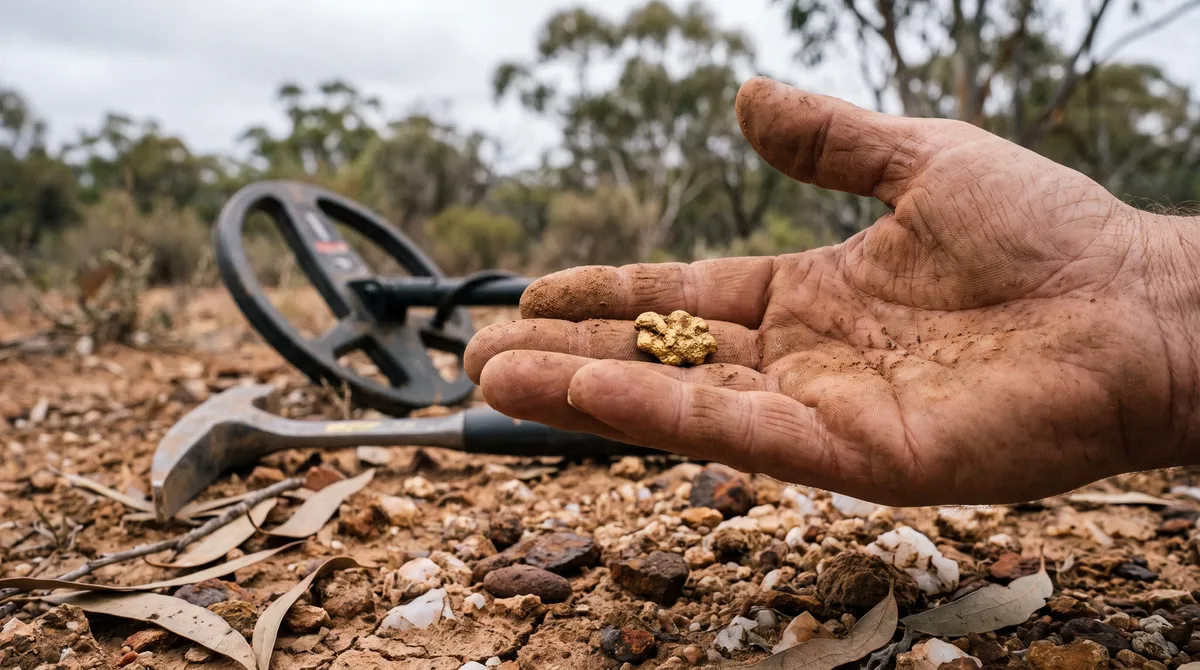
Australia holds some of the most productive detecting ground on earth, and a great deal of it is legally open to anyone who buys the right piece of paper. That combination is genuinely unusual — in most of the world, gold-bearing country is either locked up or gone.
It is also ground that punishes people who arrive with park-detecting habits. The soil is different, the targets are different, the machines are different, and the consequences of a bad decision are considerably higher when the nearest help is ninety minutes away on a track you are not sure your vehicle can handle.
This is a practical orientation to hunting the goldfields. It is general information rather than legal or safety advice — check current rules with the relevant state authority, and make your own judgements about the country you are in.
First, the paperwork
Prospecting for gold is regulated separately from searching for coins and relics, under mining legislation rather than land management rules. On Crown land where prospecting is permitted, you will generally need a Miner’s Right or fossicking licence, issued by each state individually and not transferable between them.
Two things people get wrong often enough to be worth stating plainly:
- A Miner’s Right permits prospecting. It does not exempt you from heritage law, national park prohibitions, Aboriginal cultural heritage protections, or trespass.
- A large amount of good WA ground sits inside active mining tenements. Being on Crown land is not the same as being on ground you may prospect, and the tenement holder’s permission is a separate question.
Our guide to Australian detecting rules covers the state-by-state picture and the four questions worth answering about any piece of ground before you go.
Where the gold country is
Victoria is the classic. The Golden Triangle — roughly bounded by Ballarat, Bendigo and Maryborough, taking in Castlemaine, Dunolly and Wedderburn — produced extraordinary quantities of shallow alluvial gold in the 1850s and continues to give up nuggets to detectorists today. It is the most accessible option for most people: reasonable roads, towns nearby, and a lot of legal ground. The permissions there have enough detail of their own to warrant a dedicated Victorian guide.
The trade-off is pressure. This country has been detected continuously since the technology existed, so the easy ground is thoroughly worked. What remains rewards patience, careful coverage, and a willingness to go over what everyone else has already been over — slower, lower, and with better technique.
Western Australia is the opposite proposition. The eastern goldfields around Kalgoorlie, Leonora and Laverton cover an area larger than many countries, with vastly less detecting pressure per square kilometre. It is also remote, hot, and unforgiving, and the tenement situation is complicated. This is serious expedition country rather than a weekend trip, and our Western Australian guide covers the tenement question in detail.
New South Wales and Queensland both have historic fields, and Queensland’s designated fossicking areas are the simplest legal starting point anywhere in the country if you want to try prospecting without navigating the tenement question first. We cover both states in their own guides: NSW and Queensland.
South Australia, Tasmania and the Northern Territory have smaller fields and rules that differ sharply from the big goldfield states. Each has its own guide: South Australia, Tasmania and the Northern Territory.
Why your park detector will struggle
This is the part that surprises people arriving from coin and relic hunting.
Gold nuggets are poorly conductive and often tiny. A sub-gram nugget presents almost nothing to a machine optimised for a silver coin. Worse, gold typically reads low — in the same range your detector has been telling you means iron.
Goldfields soil is heavily mineralised. Ironstone, laterite, and hot rocks generate a constant background response that a general-purpose detector interprets as targets. Turn the sensitivity up enough to hear small gold and the machine becomes unusable noise.
Prospectors solve this in one of two ways:
- High-frequency VLF detectors run at frequencies well above general-purpose machines, which makes them far more responsive to small, low-conductive targets. They give useful target information and handle moderate mineralisation with careful ground balancing.
- Pulse induction (PI) machines transmit differently and are much less troubled by mineralisation, which is why they dominate in the worst WA ground. The trade-off is that they offer little discrimination — you dig essentially everything — and they are heavier and more expensive.
Neither is a beginner’s first purchase, and neither is necessary to try the goldfields. But it is worth knowing before you drive nine hours and conclude the ground is empty when the truth is your machine cannot hear what is in it. Our buying guide covers the general principles; goldfields work is the one genuine case where specialised gear really does change the outcome.
Ground balancing is not optional here
In a park you can often ignore ground balance and get away with it. In mineralised goldfields soil you cannot.
Ground balance tells the detector what the soil itself sounds like so it can subtract it. Get it right and small targets emerge from the background. Get it wrong and you are either deaf to anything small or drowning in false signals. The ground also changes as you move — sometimes within a few metres — so this is something to redo regularly through the day rather than set once at the car.
Expect hot rocks: individual mineralised stones that read as solid targets and are not. Learning to recognise their particular sound is a large part of goldfields competence, and it is why logging what you dug matters so much here. Recording that a certain response at a certain site was a hot rock rather than a target is exactly the kind of pattern that separates a productive second visit from a repeat of the first. Our settings log guide covers keeping track of what you ran and why.
Reading the country
Gold is not randomly distributed, and the landscape tells you where to look if you know what you are reading.
Old workings are the strongest signal available. The diggers of the 1850s were extremely good at finding gold and had no metal detectors. Where they concentrated, gold was. Look for shallow surface scrapes, mullock heaps, water races, puddling depressions, and the linear scars of alluvial workings along creek lines.
Work the edges, not the middle. The heavily worked ground has been detected to death. The productive margins are the areas the old-timers walked past — the ground between two sets of workings, the slope above a gully rather than the gully floor, the spoil heaps themselves, and the tracks and camps around the diggings.
Follow the geology. Quartz reefs and their weathered outcrops are the primary source; alluvial gold has moved downhill and downstream from them. Gullies, ancient buried leads, and the inside bends of old watercourses concentrate heavy material. Gold is dense, so it behaves like other heavy things in moving water — it drops where the energy drops.
Ironstone and laterite country is often a good sign for gold and simultaneously the hardest ground to detect in. That tension is the whole game.
Old parish plans, historic mining maps and geological survey records are freely available for much of Victoria in particular, and an evening with them beats a day of wandering. This is exactly the research phase our hunt planner guide is built around.
Technique in mineralised ground
Everything slows down.
Swing low and slow. Coil-to-ground contact matters more here than almost anywhere. Small gold at depth in bad soil is a faint whisper, and lifting the coil ten centimetres removes it entirely.
Overlap heavily. Half a coil width per swing, minimum. The targets are small and the detection envelope is correspondingly small.
Dig everything, at least at first. Small gold sounds like small trash, and until you have a personal record of what a given response means in that specific ground, discrimination is guesswork. This is precisely the situation the keeper-rate guide describes: the asymmetry between digging a nail and walking past a nugget is enormous.
Grid properly. Featureless scrub makes it very easy to convince yourself you have covered ground you have not. Marking your worked lines with GPS pins is worth more here than in any park, because there are no landmarks to navigate by.
Take the trash out. Old workings are littered with boot tacks, tin fragments, and wire. Every piece you carry out is one that will never mask a nugget again.
Safety is the part that actually matters
The legal risks are manageable. The environmental ones deserve genuine respect.
Shafts. Historic goldfields are riddled with unmarked vertical shafts, many of them deep, many concealed by fallen timber and regrowth. Some have rotting covers that look solid. This is a real and recurring cause of serious injury and death. Watch where your feet are going, never walk backwards while swinging, and never step on anything covering a hole.
Heat and water. Carry far more water than you think you need, and then carry more. Detecting is sustained physical work, usually in open sun, and heat exhaustion arrives faster than people expect.
Communications. Much of the good country has no mobile coverage at all. A PLB or satellite messenger is standard equipment for anyone going out alone, and someone at home should always know where you are going and when you will be back.
Snakes. Boots, gaiters, awareness, and a pressure bandage in the pack.
Vehicle. Recovery gear, spare fuel, spare water, and an honest assessment of the track before you commit to it. A great many rescues are of people whose vehicles were fine and whose judgement was not.
Fire restrictions. During total fire bans, vehicle access to grassland can be restricted or prohibited outright, and the penalties are severe. Check before you leave.
Log it, because the goldfields reward memory
Goldfields hunting generates exactly the kind of detail that is impossible to hold in your head and enormously valuable a season later: which gully produced, what the ground balance was doing, where the hot rock patches are, which tracks are passable after rain, and which corner of a lease you have already gridded.
Record the location of every find precisely, along with depth and what your machine was doing at the time. Nuggets cluster — where there was one there are frequently more — so an accurate pin is often worth more than the piece itself. A logbook turns a trip into a map you can come back to, and the patterns sharpen with every visit.
And keep those locations to yourself. Productive goldfields ground stays productive precisely as long as it stays quiet, which is the whole argument for keeping detecting locations private.
Australia gives you the ground. Preparation and a decent record are what turn it into finds.
Frequently asked questions
Where are the best metal detecting goldfields in Australia?
Victoria's Golden Triangle around Ballarat, Bendigo, Maryborough and Castlemaine is the most famous, and still produces. Western Australia's eastern goldfields around Kalgoorlie cover an enormous area. New South Wales and Queensland both have historic fields with designated fossicking areas. All of them require the correct authorisation before you swing a coil.
Do I need a special detector for gold prospecting?
Effectively yes. Gold nuggets are small and poorly conductive, and goldfields soil is heavily mineralised, so general-purpose coin machines struggle badly. Prospectors use either high-frequency VLF detectors or pulse induction machines, both designed to handle mineralised ground and tiny low-conductive targets.
Can I keep gold I find in Australia?
Generally yes, provided you hold the correct Miner's Right or fossicking licence for that state and you are on ground where prospecting is permitted. That authorisation does not override heritage law, national park rules, native title, or a tenement holder's rights, so the permission question always comes first.
Is it safe to detect around old mine workings?
Treat them with real caution. Historic goldfields are full of unmarked and partially collapsed shafts, often hidden by vegetation, and they are a recurring cause of serious accidents. Never walk backwards while swinging, never assume a covered shaft is sound, and never go out alone without telling someone your route and return time.
Keep reading
Beach Detecting After a Storm: Reading Sand Movement
Storms strip sand and expose years of lost jewellery. Here is how to read cuts, scallops and black sand, when to go, and how to work a scoured beach safely.
Beach Metal Detecting: Tides, Salt, and Settings
Beaches hide gold but punish the unprepared. How to read tides and sand zones, stop salt from wrecking your signals, and protect your gear from corrosion.
Planning a Better Metal Detecting Hunt
Weather, soil, tides, access, and safety — plan your hunt before you leave home to waste fewer trips and dig more. A practical pre-hunt checklist.