Metal Detecting in Western Australia: Miner's Right and Tenements
In WA a metal detector counts as prospecting. What a Miner's Right allows, how tenements, pastoral leases and 40E permits work, and where the gold is.
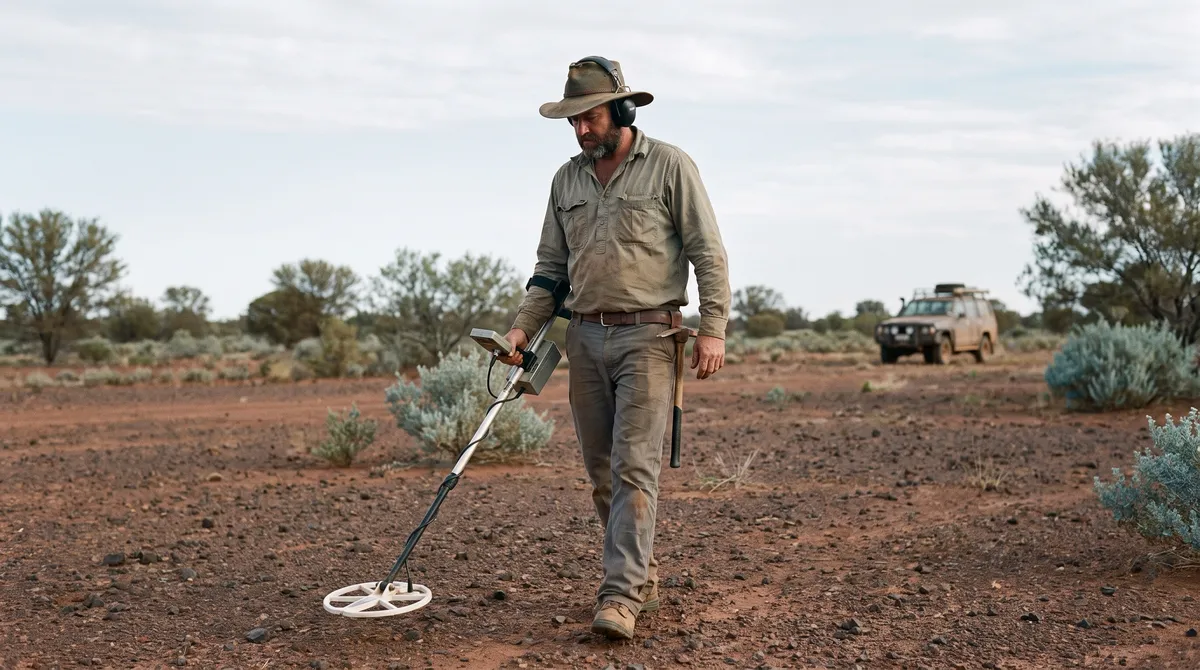
Western Australia has more gold-bearing ground open to the public than anywhere else in Australia, and the permit that opens it is inexpensive and straightforward to get. That is the easy part.
The hard part is tenure. A huge share of the WA goldfields sits under mining tenements — exploration licences, prospecting licences, mining leases — and a Miner’s Right counts for very little on ground somebody else holds. In WA the question is less “am I licensed?” than “whose ground is this, today?”
This is general orientation rather than legal advice. Tenure changes constantly, and the details of any particular block can flip the answer — check the current position with the department and the land holder before you dig.
For the national picture, start with our guide to metal detecting rules across Australia. The eastern states work very differently, as our guides to Victoria, NSW and Queensland show.
A metal detector means prospecting
WA’s Mining Act 1978 treats the search for minerals with a metal detector as prospecting, and prospecting needs a Miner’s Right. Each person needs their own. They are issued by the Department of Mines, Petroleum and Exploration — older pamphlets carry its previous name, the Department of Mines, Industry Regulation and Safety — online or at any Mining Registrar’s office, with proof of identity. Check the current fee on the department’s site rather than trusting a figure from a forum.
A Miner’s Right lets you:
- pass over Crown land to reach ground you are allowed to prospect;
- prospect on available land, meaning Crown land that is not covered by a mining tenement;
- remove up to 20 kilograms of samples on each occasion, and keep the minerals you find as your own property;
- camp on Crown land while you prospect.
The conditions are short. Use hand-held tools only and no explosives, backfill every hole and leave it safe, take all reasonable steps to prevent fire, and do not let your dogs, firearms or vehicle damage property or stock. You are liable to pay compensation for damage you do not make good. A police officer or authorised officer can ask to see your Miner’s Right and ask what you are doing, and refusing is an offence. Prospecting with no authorisation at all is a far more serious one.
Watch the vocabulary. In WA, “fossicking” means collecting rocks, ores and minerals other than gold or diamonds for a hobby or collection, and a metal detector is not a permitted fossicking tool. Gold detecting is prospecting. Forum advice written for NSW or Queensland, where fossicking includes gold, does not carry across.
And as everywhere, searching a Perth beach for lost jewellery is not prospecting. That is the local government’s decision.
Available land, and whose tenement it is
In the Mining Act, Crown land excludes reserves, townsites, freehold land and most leases, but it includes pastoral leases. Available land is the part of that Crown land not under a mining tenement. Anywhere else, you need something more.
Mining tenements. Prospecting on a tenement needs the written permission of the tenement holder. There is no exception for ground that looks abandoned or pegs that have fallen over.
Granted exploration licences. Here there is a second option: a Section 40E permit. A Miner’s Right holder can apply for a permit to prospect a nominated area of an exploration licence, described in graticular blocks, with hand-held tools, for three months. The licence holder’s consent is not required, but they are notified and have 21 days to raise concerns, and the permit cannot be used until they respond or that period ends. The 40E system is the main way into the enormous areas of WA covered by exploration licences.
Checking tenure. The department’s TENGRAPH Web maps mining tenements against other land information, and it is the tool for checking the ground you plan to walk. Check it close to the trip, not once in the off-season. Tenure changes, applications get lodged, and ground that was available in autumn can be under a live tenement by spring.
Pastoral stations
Much of the goldfields is pastoral lease. Miner’s Right holders can prospect it where it is not under a granted tenement, provided they notify the pastoralist first — where you will be and for how long.
Some station land is protected. Without the occupier’s consent, you cannot prospect:
- on land under crop, or within 100 metres of it;
- within 100 metres of a yard, stockyard, garden, cultivated field, orchard, vineyard, plantation, airstrip or airfield;
- within 100 metres of occupied land with a house or other substantial building on it;
- on or within 100 metres of a cemetery or burial ground;
- within 400 metres of the outer edge of a pastoral water point — any water works, race, dam, well or bore.
You may still pass over that land to reach available ground. When you do, cause as little inconvenience as possible, comply with the pastoralist’s reasonable requests, keep your trips across it to a minimum, and make good any damage. The water-point rule is the one people miss, and it matters: in dry country, bores and dams are how a station runs.
Native title. A Miner’s Right gives no lawful access to land subject to exclusive-possession native title. There you need the permission of the relevant native title party.
Freehold land. Searching for minerals on private property needs a permit to enter, not just a Miner’s Right.
Where you cannot go
National parks, nature reserves, townsites, and other classified reserves such as cemeteries are closed to prospecting.
Aboriginal heritage. WA’s Aboriginal Heritage Act 1972, restored and amended in November 2023 when the short-lived 2021 Act was repealed, protects Aboriginal sites and objects, and it applies to places whether or not they appear on the register. Stone artefact scatters occur right across the goldfields. If you find what may be an artefact, stop, leave it where it is, note the location and report it.
Heritage places. Old townsites, batteries and mining ruins can be heritage-listed. Check before detecting around them, and never dig into a structure.
The goldfields
The eastern goldfields rush began with Bayley and Ford’s find at Coolgardie in 1892 and Paddy Hannan’s at Kalgoorlie in 1893. From there the fields run north through Menzies, Leonora and Laverton, south towards Norseman, and west to Southern Cross. The Murchison around Cue, Mount Magnet and Meekatharra, and the Pilbara around Marble Bar and Nullagine, are more remote again.
The scale of the big finds is unlike anywhere else. The Golden Eagle, found at Larkinville by Jim Larcombe’s 17-year-old son in January 1931, weighed more than 1,100 troy ounces and was the largest nugget found in WA up to that time. The Normandy Nugget, 25.5 kilograms, was found near Kalgoorlie in 1995 and is on display at the Perth Mint. The ground is still producing.
It is also some of the hardest ground in the country to detect. WA goldfields soil is heavily mineralised — ironstone, laterite, salt and hot rocks — which is why pulse induction machines dominate out here. Detecting pressure per square kilometre is low, but the ground near towns and roads has been walked for decades. The spoil around old workings, the old dryblowing areas and the margins of known patches are where most people start.
Our Australian goldfields field guide covers PI versus VLF, ground balancing and reading old workings, and our settings log guide covers keeping track of what worked on which ground.
Beaches and shipwrecks
Perth’s beaches and the coast from Esperance to Broome are local-government territory for coin and jewellery detecting. Ask the specific council or shire, and get the answer in writing.
The WA coast adds something the east does not have in the same way: four centuries of shipwrecks. The Dutch East India Company lost the Batavia in 1629, the Vergulde Draeck in 1656, the Zuytdorp in 1712 and the Zeewijk in 1727 on this coast, and many more ships followed. WA’s Maritime Archaeology Act 1973 protects ships lost before 1900 and their relics, and a protected maritime archaeological site can be on land or between the tide marks as well as underwater — survivor camps included. The Commonwealth Underwater Cultural Heritage Act 2018 protects wrecks and their relics once they are more than 75 years old. Reporting a new find is a legal requirement under both.
In practice, an old coin, fitting or piece of ship’s hardware on a beach near a known wreck may well be a protected relic. Leave it, record exactly where it is, and report it to the WA Museum. The Zuytdorp itself was identified from silver coins dated 1711.
Our beach detecting guide covers the technical side of salt and wet sand.
Safety
Most WA prospecting is expedition country, and it should be planned that way.
Heat and water. Goldfields summers regularly pass 40°C, and most prospectors work the cooler months. Carry far more water than you plan to drink, plus extra for the vehicle.
Distance. Fuel, spares, recovery gear, and a vehicle you trust on corrugated station tracks. Tell someone your route and return date. A PLB or satellite messenger is standard equipment.
Getting turned around. Flat mulga country has very few landmarks. Mark the vehicle on your GPS before you walk away from it.
Shafts. The goldfields are riddled with old workings, many of them open. Never walk backwards while swinging.
Snakes. Boots, gaiters and a pressure bandage in the pack.
Keep the paperwork with the finds
WA’s rules generate a particular kind of record: which tenements you checked and when, the dates and blocks on a 40E permit, any written consent from a tenement holder, and which pastoralist you notified. If anyone asks — an authorised officer, a tenement holder’s field crew, the station manager — that is the information you need to hand.
A logbook covers it. DetectingLog keeps a GPS pin and notes with every hunt, so the pin shows where you were and the note records the permission you were there under. Over a season it also turns a sprawling trip into a map you can come back to, which matters because nuggets cluster.
Keep productive patches to yourself. A patch that gets talked about in town does not stay a patch for long, which is the argument for keeping detecting locations private.
The Miner’s Right is the easy part. Check the tenure, notify the station, stay clear of the bores and the relics, and WA has more open gold country than anyone could walk in a lifetime.
Frequently asked questions
Do I need a Miner's Right to metal detect in Western Australia?
To search for gold or other minerals, yes. WA treats searching for minerals with a metal detector as prospecting under the Mining Act 1978, and each person needs their own Miner's Right, issued by the Department of Mines, Petroleum and Exploration. Searching a council beach for lost coins and jewellery is a different activity, governed by the local government that manages the beach.
Can I metal detect on a mining tenement in WA?
Only with the written permission of the tenement holder or, on a granted exploration licence, with a Section 40E permit. A 40E permit lets a Miner's Right holder prospect a nominated area of an exploration licence with hand-held tools for three months. The licence holder is notified and can raise concerns, and the permit cannot be used until they respond or 21 days pass.
Can I prospect on a pastoral station in WA?
Often, yes. Pastoral lease land is open to Miner's Right holders where it is not covered by a granted mining tenement, provided you notify the pastoralist first. Without the occupier's consent you cannot prospect within 100 metres of crops, stockyards, occupied houses and similar improvements, or within 400 metres of a pastoral water point such as a bore, well or dam.
Keep reading
Miner's Right Victoria: Cost, How to Get One and the Rules
A Victorian Miner's Right costs $29.40 for 10 years, rising to $41.40 on 1 January 2027. How to buy one, what it lets you do, and the rules attached.
Metal Detecting in the Northern Territory: Permit and Land Access
The NT has required a fossicking permit since June 2026. How the free permit, fossicking notices, pastoral land, Aboriginal land and gold limits work.
Metal Detecting in South Australia: No Permit, Always Permission
South Australia needs no fossicking permit, but every block needs someone's consent. How Crown land, parks, Jupiter Creek and Mount Crawford work.