Miner's Right Victoria: Cost, How to Get One and the Rules
A Victorian Miner's Right costs $29.40 for 10 years, rising to $41.40 on 1 January 2027. How to buy one, what it lets you do, and the rules attached.
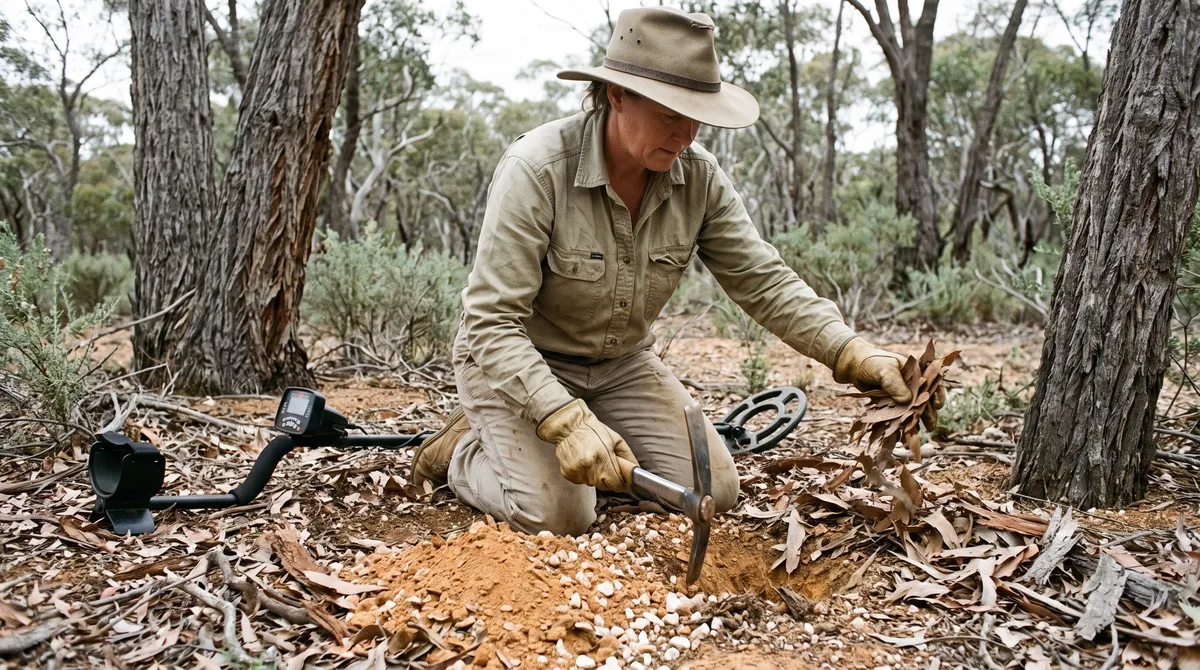
The Miner’s Right is the cheapest piece of paper in Australian prospecting. It costs less than a tank of fuel, takes a few minutes to buy online, and lasts ten years. It is what makes prospecting on the Victorian goldfields legal, and it is what an inspector will ask to see.
It is about to get more expensive. Regulations made in August 2026 raise the fee from 1 January 2027. This guide covers what a Miner’s Right costs now and after that date, how to buy one, what it lets you do, and the conditions you agree to when you take it out.
This is general orientation rather than legal advice. Rules, fees and park boundaries change, so check with Resources Victoria and the land manager before you dig.
For the wider picture of detecting in the state, from the Golden Triangle to council beaches, see our guide to metal detecting in Victoria.
What a Miner’s Right is
A Miner’s Right is a permit to search for minerals under the Mineral Resources (Sustainable Development) Act 1990. Gold, gemstones and other minerals all count, and a metal detector is one of the tools it covers.
It matters because of how Victorian law treats minerals. They belong to the Crown. Section 8 of the Act makes it an offence to prospect, fossick or otherwise search for minerals on any land without an authority, and that includes land you own. Service Victoria says it directly: you need a Miner’s Right to prospect on your own land.
What it does not cover is the other half of the hobby. Hunting a council beach for dropped rings, or a sportsground for old coins, is not a search for minerals, and the permission you need there comes from the council or committee of management. A Miner’s Right does not get you onto a beach, and a council permit does not let you prospect for gold.
What it costs, and the January 2027 increase
A Miner’s Right costs $29.40 and lasts 10 years. That is the same flat fee whoever you are and wherever you plan to use it.
The fee is set in the Mineral Resources (Sustainable Development) (Mineral Industries) Regulations 2019 as 1.7 fee units, and Victoria re-values its fee unit every 1 July. For 2026–27 a fee unit is worth $17.27, which is how 1.7 units becomes $29.40.
On 18 August 2026 the Victorian Government made the Mineral Resources (Sustainable Development) (Mineral Industries) Amendment (Fees) Regulations 2026, the result of a cost-recovery review of the fees Resources Victoria charges. From 1 January 2027 the Miner’s Right fee rises from 1.7 to 2.4 fee units. At the 2026–27 value that is $41.40, and it will move again when the fee unit is re-valued on 1 July 2027.
Two practical points follow:
- A Miner’s Right starts on the day you buy it. Service Victoria does not let you choose a future start date, so you cannot buy now and hold it for later.
- If you don’t have one yet, or yours is close to running out, buying before 1 January costs $12 less for the same ten years. If yours still has years left, buying a new one early mostly restarts the clock.
How to buy one
Online through Service Victoria. This is the quickest route, and Service Victoria estimates about three minutes. You give your name and address, pay, and receive a PDF of your Miner’s Right by email. Print it or keep it on your phone: either is fine to show an inspector.
In person from an authorised agent. Resources Victoria publishes a short list of agents, mostly visitor information centres and government offices in regional Victoria, such as Beechworth, Yackandandah and the Northern Grampians Shire Council in St Arnaud. Check the current list and opening hours before you drive anywhere.
When it expires, buy a new one the same way. It runs for ten years from that day.
If you lose it, email the Department of Energy, Environment and Climate Action’s customer service team with your name, your address when you bought it, your date of birth, the Miner’s Right number if you know it, and where you bought it. They can send a copy.
Children under 18 don’t need their own, as long as they are with an adult who holds a current Miner’s Right. Every adult prospecting in the group needs their own.
It is Victorian only. Service Victoria is explicit that it is not valid interstate. Each state and territory runs its own system, and our guides to NSW, Queensland, Western Australia, South Australia, Tasmania and the Northern Territory cover them.
What it lets you do
Section 55 of the Act sets out what the Miner’s Right allows. Read it as three entitlements.
You can search for minerals on Crown land that is open to it. That means Crown land that has not been exempted, which in practice is mostly state forest, plus mapped areas in a small number of parks.
You can search on private land with the owner’s or occupier’s consent. That consent can come with conditions and can be withdrawn at any time. Resources Victoria says verbal permission is allowed but recommends getting it in writing. Our guide to asking for permission covers how.
You keep what you find. When you are validly on the land, you may remove any minerals you discover there, and section 11 of the Act passes ownership from the Crown to you the moment the find is separated from the ground in accordance with your Miner’s Right. Gold taken outside those terms stays the Crown’s property, which is one more reason to stay inside them.
There is one more layer. If the ground is covered by a mining licence, prospecting licence or retention licence, you also need the licence holder’s consent, on top of any landowner’s consent. An exploration licence is not on that list in section 55. Resources Victoria’s GeoVic map shows mineral tenements and heritage places, and it is worth checking before a trip to unfamiliar ground.
The conditions you agree to
The Miner’s Right itself is short. The holder agrees to search only in the circumstances section 55 allows and to comply with section 58. Section 58 says you must not:
- use any equipment to dig other than non-mechanical hand tools. Picks, shovels, sieves, shakers and metal detectors are fine; machinery is not
- use explosives
- remove or damage any tree or shrub
- disturb any Aboriginal cultural heritage
You must also repair any damage to the land caused by your search, and you must produce your Miner’s Right if an inspector asks for it.
Resources Victoria spells out what repairing damage means in practice: fill every hole, put the soil and leaf litter back, take your rubbish home rather than burying it, drive only on roads and tracks open to the public, and park on the roadside. Don’t light fires to clear ground. And if you dig up a hidden cache of valuables rather than a mineral, you must report it to Victoria Police, because it belongs to the Crown.
Inspectors do check. Resources Victoria warns that breaking the rules can mean an on-the-spot fine or court. In court, the Act’s maximum for searching without an authority is 200 penalty units, which is $41,820 at the 2026–27 value. Breaching the section 58 conditions carries up to 100 penalty units.
Where you can’t use it
Resources Victoria lists the Crown land where recreational prospecting is not allowed:
- national parks, state parks, wilderness parks and marine parks, outside specific areas set aside for prospecting
- land protected under the Aboriginal Heritage Act 2006
- reference areas under the Reference Areas Act 1978
- the Deep Lead Nature Conservation Reserve (No. 2)
- land the relevant Minister has declared off-limits
- anywhere else excluded under the Act or another Act
Rivers and creeks are a trap. Resources Victoria publishes a list of more than 200 rivers and creeks where prospecting is not allowed. It includes the Murray, Goulburn, Loddon, Campaspe, Ovens and Avoca rivers, and goldfields creeks such as Bendigo Creek and Jim Crow Creek. If your plan involves water, check the list first.
Heritage law sits on top of everything. Parks Victoria puts it plainly: holding a Miner’s Right “does not confer any rights” under the Heritage Act 2017. That Act protects every historical archaeological site in Victoria, recorded or not, and the goldfields are full of them: puddling machines, water races, hut sites and old camps. If it looks as though someone built, worked or lived on it, detect somewhere else. If you find something that may be Aboriginal cultural heritage, stop and report it to First Peoples – State Relations.
The parks with prospecting areas
Some parks keep defined areas open to Miner’s Right holders. Parks Victoria currently lists:
- Beechworth Historic Park
- Castlemaine Diggings National Heritage Park
- Chiltern-Mt Pilot National Park
- Greater Bendigo National Park and Bendigo Regional Park
- Heathcote-Graytown National Park
- Kara Kara National Park
- Kooyoora State Park
- Paddys Ranges State Park
- Steiglitz Historic Park
- Warrandyte State Park
- Wychitella Nature Conservation Reserve
Parks Victoria publishes a prospecting area map for each of them except Steiglitz, and the map is what governs, not the park’s name. Parks Victoria also posts change-of-conditions alerts that can close part of a park at short notice. Check both before you go.
What changed on 5 October 2026
On 5 October 2026 about 78,800 hectares of public land in Victoria’s central west and around Mirboo North moved to Parks Victoria. If you have prospected in the Wombat or Pyrenees forests, your old maps are now wrong.
Prospecting is no longer allowed in the new national parks, conservation parks and nature reserves:
- Wombat-Lerderderg National Park, which takes in the former Lerderderg State Park and large parts of the Wombat State Forest
- Mount Buangor National Park, which takes in parts of Mount Cole State Forest
- Pyrenees National Park, on former Pyrenees State Forest land
- Hepburn and Cobaw conservation parks, plus Mirboo North Conservation Park in the Strzelecki Ranges
Parks Victoria says prospecting continues in the new bushland reserves and in six regional parks: Bendigo (now taking in the Wellsford Forest), Hepburn, Barkstead, Blackwood, Fingerpost and Spargo Creek. Parks Victoria also lists the remaining Mount Cole, Mount Lonarch, Musical Gully–Camp Hill, Pyrenees and Trawalla Andrews state forests as still open to prospecting.
A checklist before you leave
- Miner’s Right current, printed or on your phone.
- Land status checked in GeoVic: is it Crown land open to prospecting, and is there a mining, prospecting or retention licence over it?
- Park map and alerts, if you are going into one of the parks above.
- Banned waterways list, if you are working a creek.
- Written consent from the landowner, and from the licence holder if one applies.
- Hand tools only, and every hole filled before you leave.
Keep the paperwork with the finds
A Miner’s Right is good for ten years, which is long enough to forget when it runs out. Put the expiry date in your phone’s calendar on the day you buy it.
For each hunt, note what you were relying on: the Miner’s Right on Crown land, a park’s prospecting area, a farmer’s written consent. A logbook makes that habit easy. DetectingLog keeps a GPS pin and notes with every hunt, so the pin shows where you were and the note says what you were there under. For where the gold actually sits, our Australian goldfields guide goes into the ground itself.
Ten minutes of paperwork buys ten years on the goldfields. Get the Miner’s Right before the price goes up, check the map before every trip, and fill your holes.
Frequently asked questions
How much is a Miner's Right in Victoria?
It costs $29.40 and lasts 10 years. From 1 January 2027 the fee rises from 1.7 to 2.4 fee units under the Mineral Resources (Sustainable Development) (Mineral Industries) Amendment (Fees) Regulations 2026. At the 2026–27 fee-unit value that is $41.40, and the dollar figure is re-indexed each 1 July after that.
How do I get a Miner's Right in Victoria?
Buy it online through Service Victoria, which takes a few minutes and emails you a PDF you can print or keep on your phone. You can also buy one in person from one of Resources Victoria's authorised agents, which are mostly visitor information centres and government offices in regional Victoria. It runs for 10 years from the day you buy it.
Do children need a Miner's Right to prospect in Victoria?
No. Children under 18 do not need their own Miner's Right if they are with an adult who holds a current one. Every adult who is prospecting needs their own.
Do I need a Miner's Right to prospect on my own land?
Yes. Under the Mineral Resources (Sustainable Development) Act 1990, minerals belong to the Crown until they are lawfully separated from the land, and searching for them without an authority is an offence. Service Victoria states plainly that you need a Miner's Right even on your own land.
Keep reading
Metal Detecting in the Northern Territory: Permit and Land Access
The NT has required a fossicking permit since June 2026. How the free permit, fossicking notices, pastoral land, Aboriginal land and gold limits work.
Metal Detecting in South Australia: No Permit, Always Permission
South Australia needs no fossicking permit, but every block needs someone's consent. How Crown land, parks, Jupiter Creek and Mount Crawford work.
Metal Detecting in Tasmania: Prospecting Licence and Reserves
In Tasmania a detector needs a prospecting licence, is banned from fossicking areas and cannot be carried onto reserved land. How the rules fit together.