

Metal Detecting in NSW: Fossicking Rules, Forests and Goldfields
NSW needs no fossicking licence, but it has permits, take limits and a strict relics law. Where you can detect in New South Wales and where you cannot.
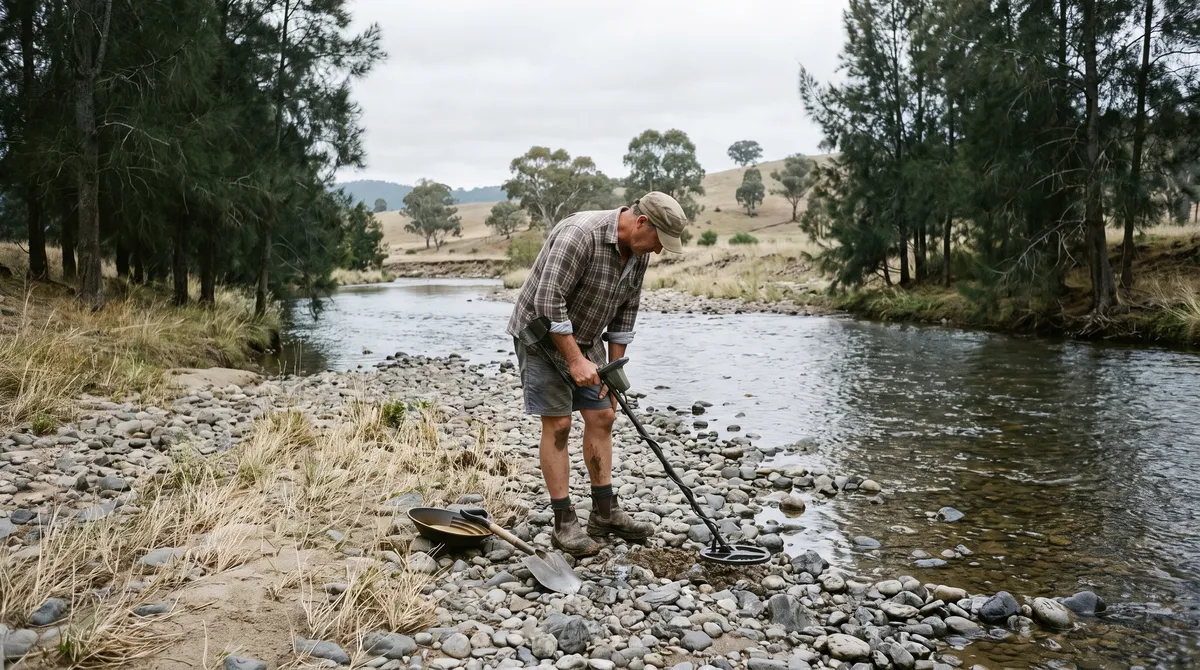
New South Wales is where the Australian gold rush started. The first payable gold came out of Ophir, near Orange, in 1851, and within a few years the Turon, Araluen, Lambing Flat and a string of other fields had drawn diggers from around the world.
It is also the state with the lightest-looking rulebook. There is no fossicking licence in NSW at all. That is genuinely useful, and it is also easy to misread. NSW has not removed the permission question, it has moved it: instead of one state licence, you deal with whoever controls the ground, and you work inside a set of limits that Victoria and Queensland do not have.
This is general orientation rather than legal advice. Rules change, reserves get reclassified, and the details of any particular block can flip the answer — check with whoever manages the land before you dig.
For the national picture, start with our guide to metal detecting rules across Australia. If you also detect south of the border, our Victorian guide covers the Miner’s Right system there.
No licence, but plenty of rules
NSW regulates fossicking — the small-scale search for and collection of minerals, gemstones and mineral-bearing material — under the Mining Act 1992 and the Mining Regulation 2016. The Resources Regulator’s own guide is plain about it: there is no state-wide licence, and fossicking is lawful once you have the right consents.
Metal detectors are expressly allowed, and have been since a 2010 change to the regulation. So are the hand tools you would expect: picks, shovels, sieves, pans, shakers and non-powered sluices. What is prohibited is explosives and any power-operated equipment used to disturb, dig or process material — water pumps, highbankers run off a pump, powered trommels, dredges and concentrators.
Three limits matter more in practice than people expect:
- Disturbance. No more than one cubic metre of soil, rock or other material disturbed in any 48-hour period. Stockpile what you dig and put it back so the soil profile is restored. Bushrock must not be moved or damaged.
- What you can take. Per person, in any 48-hour period: 50 grams of gold in pieces under 10 grams, up to five nuggets of 10 grams or more, 10 kilograms of mineral-bearing material, 5 kilograms of other minerals and 100 grams of gemstones.
- Ownership. Publicly owned gold and gemstones become yours when you recover them through lawful fossicking, and no royalty is payable. Where the minerals are privately owned, agree ownership with the landholder first.
Breaches can bring an on-the-spot fine, and considerably more if they end up in court.
One distinction runs through all of this. Searching a council beach for lost rings is not fossicking, because coins and jewellery are not minerals. The rules above neither allow it nor forbid it; the land manager’s rules and heritage law are what apply.
Who you need permission from
“No licence” means the permission comes from whoever controls the land, and in NSW that can be one of several parties.
Private land: the landholder. You need the landholder’s consent, and you must follow their conditions about tracks, paddocks, gates and timing. Worth knowing before you knock on the door: section 383C of the Mining Act indemnifies landholders against liability arising from fossickers’ use of their land in most circumstances. Liability is often the first worry a farmer raises, and that is a genuine answer to it.
State forests: the Forestry Corporation. Fossicking in a NSW State forest needs a Forestry Corporation permit. It runs for 12 months, it is available to individuals and families, and one permit covers State forests across NSW. It does not open every hectare — parts of some forests are closed for safety, environmental, cultural or operational reasons, and the Forestry Corporation publishes maps of where fossicking is and is not allowed. Fossicking in a State forest without a permit is an offence under the Forestry Act 2012.
Crown land: it depends on the parcel. The Mining Act gives a right of entry for fossicking over certain types of Crown land. Elsewhere, access needs authorisation under the Crown Land Management Act 2016, and leased or licensed Crown land needs the lessee or Crown Lands. A great many NSW beaches, parks and showgrounds are Crown reserves run by a council as Crown land manager, and then the council’s permission is the one that counts. Crown Lands will tell you the status of a parcel if you ask.
Mining titles: the title holder. Land under an exploration licence, mining lease, mineral claim or opal prospecting licence needs the holder’s consent — with one useful exception. The state has declared a number of Fossicking Districts, and inside them you do not need consent from exploration licence holders. The boundaries are on the Fossicking Districts layer of the government’s MinView map, alongside the titles themselves.
Native title land: the native title holders. Fossicking on land or waters subject to native title needs the consent of the registered native title body corporate. NTSCORP, the native title service provider for NSW, can help you work out whether an area is affected.
Where you cannot go
National parks and most reserves. NPWS policy is that fossicking is generally not permitted in parks, and the National Parks and Wildlife Regulation 2019 makes digging up or removing soil, rock or minerals an offence without consent. Nature reserves, historic sites, Aboriginal areas, wilderness areas and most karst reserves are not even considered. At the time of writing, NPWS lists just three reserves where fossicking — detecting, panning and hand sluicing — is allowed under the plan of management: Torrington State Conservation Area, Nuggetty State Conservation Area near Tuena (away from the banks and flats of Tuena Creek), and the Grove Creek area of Abercrombie Karst Conservation Reserve. Check the current policy before relying on that list.
Relics. This is the NSW trap, and it catches relic hunters rather than gold hunters. Under the Heritage Act 1977, a relic is any deposit, artefact, object or material evidence relating to the non-Aboriginal settlement of NSW that is of State or local heritage significance. The definition is not about age. You must not disturb or excavate land when you know, or have reasonable cause to suspect, that doing so will expose, move or damage a relic, unless you hold an excavation permit, and anyone who discovers a relic must notify the Heritage Council. A landholder’s permission does not change any of that. Old homestead sites, inn and coach-stop sites, gold rush camps and hut sites are exactly where this applies. If the ground looks like a significant historic site, detect somewhere else.
Aboriginal objects. The National Parks and Wildlife Act 1974 protects Aboriginal objects and places whether or not they are recorded, and harming an Aboriginal object is an offence even if you did not know what it was. If you turn up what may be an artefact, stop, disturb nothing further, note the location and report it to Heritage NSW.
Waterways. Creek detecting is classic NSW gold country, and the Fisheries Management Act 1994 applies to it. Do not remove snags longer than three metres, boulders more than half a metre across, or aquatic vegetation from the bed or banks, and do not build anything across a creek that could block fish passage.
The goldfields
The historic ground spreads across the Central West and the tablelands. Ophir, where Edward Hargraves and his partners found payable gold in 1851, is now a reserve on Summer Hill Creek where fossicking has long been part of the visit — check the reserve’s current conditions before you go. From there the old fields run through the Turon at Sofala and Hill End, Gulgong, Lambing Flat at Young, Tuena and the Abercrombie, and down to Araluen and Majors Creek near Braidwood. Hill End is also where the Holtermann specimen came out of the ground in 1872, a slab of gold and quartz often described as the largest single specimen of reef gold ever found.
Much NSW gold is alluvial and creek-bound. Gravel bars, bedrock cracks, the inside of old bends and the spoil the diggers left along the banks all still produce, because the 1850s fields were worked with pans, cradles and sluices that lost fine gold and never reached what lay deeper. The ground is mineralised, though usually less severely than central Victoria or the WA goldfields, and it changes quickly along a creek line. Ground balance as you go, keep the sensitivity at the highest setting the ground will hold steadily, and treat a low target ID as possible gold rather than certain junk.
Further north, the New England tablelands around Inverell and Glen Innes are sapphire country, and Torrington is known for topaz. That is sieve-and-shovel work rather than detector work, but the same fossicking rules apply.
Our Australian goldfields field guide covers reading old workings and why a general-purpose detector struggles with small gold, and our guides to detector settings and VDI numbers go into the technical side.
Beaches, parks and council land
For most NSW detectorists the local option is the coast — Sydney’s beaches, the Central Coast, the Illawarra and the long stretches north and south — plus parks and sportsgrounds.
Coins and jewellery are not fossicking, so the answer here comes from the land manager: usually the council, often acting as Crown land manager for a Crown reserve. Councils take different positions. Some allow detecting, some want a permit, some restrict it to certain areas or times, and some say no. Ask the specific council’s open space or beach team, preferably in writing, and keep the reply. Dune systems and bush regeneration areas are off-limits regardless.
Our check-before-you-dig checklist sets out the general framework, and beach detecting covers salt, tides and wet-sand settings.
Private land is still the best ground
Rural NSW is enormous and lightly detected, and the ground around old homesteads, woolsheds, stock routes and village sites carries 150 years of dropped material. Remember the relics point above: the ground is private, but the Heritage Act still applies.
The conversation is the same as anywhere. Be direct, explain what you do, promise to fill every hole, take the rubbish out, offer to show them everything you find, and mention the section 383C indemnity. Our guide to asking for permission covers the conversation and the simple written agreement worth having afterwards.
Ask about stock, gates, crops and lambing, and take the bush fire danger period seriously. During a total fire ban, driving through long grass is how a very bad day starts.
Safety
Old shafts. The Turon, Gulgong and Araluen fields all have unmarked workings, some hidden in long grass. Watch your feet and never stand on a covered shaft.
Creeks rise fast. Storm rain upstream can put a creek over its gravel bars with little warning. Keep an eye on the weather in the catchment, not just where you are standing.
Heat, snakes and coverage. Water, boots, gaiters, a pressure bandage, and someone who knows where you are. Carry a PLB if you are working alone in the gorges, where mobile coverage drops out.
Keep the paperwork with the finds
NSW’s rules reward good records. The 48-hour take limits are easy to keep to if you log each hunt with its date and what you kept, and hard to demonstrate if you did not. The Forestry permit has an expiry date. Every landholder has conditions, and no two sets are the same.
A logbook handles most of it. DetectingLog records a GPS pin and notes with every hunt, which is enough to record whose ground it was, what the conditions were and what came home, in one place you can pull up on your phone if someone asks.
And keep productive spots to yourself. Creek gold near a road does not stay quiet for long, which is the whole argument for keeping detecting locations private.
NSW asks for less paperwork than its neighbours and more judgement. Get the consents, stay inside the limits, leave the relics alone, and the country the rush started in still has gold in its creeks.
Frequently asked questions
Do I need a licence to metal detect in NSW?
No. NSW has no fossicking licence. Fossicking for gold with a metal detector and hand tools is lawful across much of the state, but you need the consent of whoever controls the land: the landholder on private land, a Forestry Corporation permit in State forests, and the right Crown land or council authority elsewhere. Searching a council beach for coins and jewellery is not fossicking, and the council that manages the beach sets the rules there.
Can I metal detect in NSW national parks?
Generally no. NPWS policy is that fossicking is not permitted in parks, and the National Parks and Wildlife Regulation 2019 makes digging up or removing soil, rock or minerals an offence without consent. At the time of writing only three NPWS reserves allow it under their plans of management: Torrington State Conservation Area, Nuggetty State Conservation Area near Tuena, and the Grove Creek area of Abercrombie Karst Conservation Reserve. Check the current NPWS fossicking policy before you go.
How much gold can I keep when fossicking in NSW?
The Mining Regulation limits what one person can take in any 48-hour period: 50 grams of gold in pieces under 10 grams, plus up to five nuggets of 10 grams or more, along with limits on mineral-bearing material and gemstones. Publicly owned gold becomes yours when you recover it lawfully, and no royalty is payable. Where the landholder owns the minerals, agree ownership with them before you start.
Keep reading
Miner's Right Victoria: Cost, How to Get One and the Rules
A Victorian Miner's Right costs $29.40 for 10 years, rising to $41.40 on 1 January 2027. How to buy one, what it lets you do, and the rules attached.
Metal Detecting in the Northern Territory: Permit and Land Access
The NT has required a fossicking permit since June 2026. How the free permit, fossicking notices, pastoral land, Aboriginal land and gold limits work.
Metal Detecting in South Australia: No Permit, Always Permission
South Australia needs no fossicking permit, but every block needs someone's consent. How Crown land, parks, Jupiter Creek and Mount Crawford work.