VDI Numbers Explained: Learn Your Detector's Signals
What VDI numbers really mean, why they shift with soil and depth, and how to build your own signal history so you dig smarter and guess less.
Updated
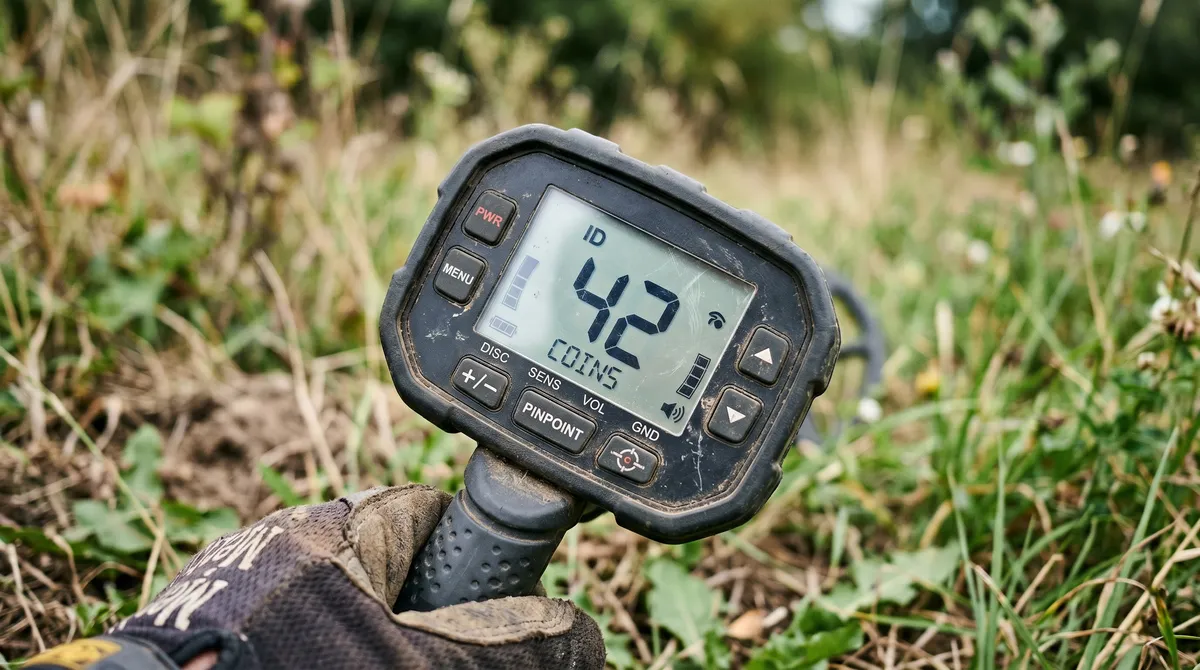
Your detector flashes “78” and you feel a little jolt of hope. But what does 78 actually mean? Sometimes a silver coin. Sometimes a big copper. Sometimes a lump of foil sitting at the wrong angle. VDI numbers are one of the most useful tools on your detector and one of the most misunderstood — so let’s get them straight.
What a VDI number actually is
VDI — Visual Discrimination Indicator, also called target ID — is your detector’s best guess at what’s under the coil, shown as a number before you dig. It works by reading how a target responds to the detector’s field. Iron and small junk respond one way, coins and silver another.
More precisely, the machine is measuring how much the target shifts the phase of the transmitted signal. Highly conductive metals like silver and copper shift it one way; iron and poorly conductive metals shift it another. The detector maps that phase shift onto a number. That is the whole trick — and understanding it explains most of the surprises, because anything that changes how a target responds also changes the number.
A rough, typical scale on a single-frequency detector:
| VDI range | Usually means |
|---|---|
| 1–20 | Iron, nails, hot rocks |
| 20–50 | Gold, foil, pull-tabs |
| 50–75 | Modern coins |
| 75+ | Silver, large copper |
Memorise the shape of that, not the exact numbers — because the exact numbers lie more often than you’d think.
Your scale is not their scale
This is the single most common way beginners get confused, and it has nothing to do with skill.
VDI scales are not standardised. They differ in range, in resolution, and sometimes in direction — not just between manufacturers, but between models from the same manufacturer. A few of the shapes you will run into:
- 0–99 is the most common layout, used across a lot of entry-level and mid-range machines.
- Negative-to-positive scales put iron below zero and run up through the conductive range. Minelab’s Equinox series is the widely cited example, running roughly −9 to 40.
- Two-dimensional displays abandon the single number entirely. Minelab’s CTX 3030 plots targets on a grid with a ferrous axis and a conductive axis, because one number genuinely cannot carry both pieces of information.
The practical consequence: a VDI chart you found on a forum is only useful if it was written for your exact model. Someone telling you “silver dimes come in at 78” is telling you something true about their detector. On yours it might be 24, or 88, or a coordinate pair. Check your own manual for the scale your machine actually uses before you trust any chart, including the one above.
Why the same target reads differently
Here’s the thing that trips up beginners: the same coin can show three different numbers on three different days. That’s not a fault. It’s physics. The reading shifts with:
- Depth — deeper targets read lower and jumpier.
- Soil mineralisation — heavy ground drags numbers around.
- Target angle — a coin on its edge reads nothing like one lying flat.
- Corrosion — a crusty relic doesn’t read like a clean one.
- Nearby junk — a nail next to a coin muddies the whole signal.
- Coil size and sweep speed — a big coil blending two targets reports their average, which may be a number neither of them would give alone.
So treat VDI as a probability, not a promise. A solid, repeatable number from several directions is trustworthy. A number that jumps around every swing is telling you “it’s complicated down here.”
The targets that lie to you
Some junk is genuinely good at impersonating treasure. These are the ones worth learning by name, because they account for most wasted digging:
Crown bottle caps are the classic. A steel cap can read solidly in the coin range and sound convincing, which is why so many detectorists dig them for years. The tell is usually cross-sweeping: rotate ninety degrees and a bottle cap often breaks up or throws an iron grunt, where a real coin holds its number from every direction.
Pull tabs and ring pulls sit squarely in the gold range and there is no honest way to separate them by number alone. This is the trade-off discussed below, and it never fully goes away.
Aluminium screw caps from bottles read high and stable — frequently higher than the coins you are hoping for.
Large iron can produce a surprisingly high reading rather than a low one. On machines where the scale wraps, a big iron object such as a buried horseshoe or plate can present in the silver range entirely convincingly. Depth and size are the clue: an enormous, booming signal that reads like a small silver coin is usually not a small silver coin.
Foil, from chocolate wrappers and old cigarette packets, scatters across the low-to-mid range and is the main reason mid-range digging feels unrewarding in picnic areas.
The mid-range problem
The most painful truth in detecting: gold and jewellery sit right in the junk zone. Rings, small gold, and foil all cluster in that 20–50 range. Discriminate it all out and you’ll never dig trash — but you’ll also walk over gold. There’s no setting that fixes this. The only real solution is knowing your own ground well enough to judge when a mid-range signal is worth the dig.
It is worth being clear about what discrimination actually does here, because the vocabulary matters. Discrimination rejects everything below a threshold. Notching rejects a specific band while leaving what sits either side of it accepted. Notching out the pull-tab band is the more surgical option, and it is still a gamble — you are betting that no gold on that site happens to read where the tabs read.
Many experienced detectorists run with almost no discrimination at all and do the filtering with their ears and their judgement instead. That means digging more junk. It also means they are the ones who find the rings.
Build a test garden
Everything above becomes concrete the moment you stop reading and go and measure your own machine. A test garden is the fastest way to do it, and it costs nothing.
Pick a patch of ground you can leave undisturbed — a corner of a garden or lawn works. Bury a known set of targets at known depths: a modern coin at 5 cm and another at 15 cm, a silver coin if you can spare one, a pull tab, a small gold item if you are brave, a nail, and a bottle cap. Record exactly what went where. Marking the spots with something non-metallic saves a lot of frustration later.
Then sweep it. Note the number each target gives, how the number changes with depth, and what happens when you cross-sweep. Do it again after heavy rain, because wet ground shifts readings noticeably and that alone explains a lot of “my detector is behaving strangely today”.
An air test — waving a target past the coil in the air — is the quicker version and useful for learning the rough position of things on your scale. Just remember it flatters the machine badly: no soil means no mineralisation, so air-test depth and stability are always better than anything you will get in the field.
Use VDI with your other senses
VDI is one input, not the whole story.
Tone carries information the number throws away. Most machines assign tones by conductivity band, so the pitch tells you roughly the same thing as the number — but your ears register texture that the display cannot show. A clean, round, repeatable tone reads differently from a scratchy, clipped one even when both produce the same digits. Detectorists who hunt in multi-tone rather than single-tone tend to develop this faster, because the audio gives them something to compare against.
Repeatability is the cheapest test you have. Sweep the target from at least two directions, ideally four. A good target holds its number and its tone from every angle. Junk and iron falses tend to fall apart the moment you approach from ninety degrees.
Your pinpointer closes the loop. Recovering the target quickly means you find out what the signal actually was while the reading is still fresh in your mind, which is what turns a dig into a lesson rather than just a hole.
Numbers plus tone plus consistency beats numbers alone every time.
Build your own “personal VDI truth”
Generic charts are a starting point. Your soil is the real teacher. The detectorists who read targets best aren’t using better charts — they’ve built a personal record of what numbers mean in the ground they actually hunt.
You do that by logging, every time:
- the VDI you saw before digging,
- the metal it turned out to be,
- the depth, and
- whether it was a keeper.
Do this across enough hunts and a real picture forms. You’ll see that at one site, 64 is reliably a coin, while at a trashy park, 64 is a coin-flip. You will also start to see the misses — the band where you keep digging junk, and the band you have been skipping that quietly held two of your best finds.
That’s knowledge no chart can give you — and it’s exactly what DetectingLog’s VDI distribution charts build for you automatically once you’ve logged your finds. Your logbook does the remembering; the charts do the pattern-spotting.
The habit compounds. A season of logged signals turns the number on your screen from a guess into a genuine prediction — and that is the point at which detecting stops feeling like luck. Our detector settings guide covers the other half of that record, and the keeper-rate guide shows what to do with the pattern once you can see it. If you are still choosing a machine, the beginner’s buying guide explains why target ID precision matters far less than the marketing suggests.
Frequently asked questions
What does VDI mean in metal detecting?
VDI stands for Visual Discrimination Indicator — a number your detector shows to estimate what kind of metal is under the coil before you dig. Low numbers usually mean iron, mid numbers mean gold, foil, and pull-tabs, and high numbers mean coins and silver.
Why do VDI numbers change for the same target?
Depth, soil mineralisation, the angle a target is sitting at, corrosion, and nearby junk all shift the reading. The same coin can show different numbers in different ground, which is why a VDI is an estimate, not a guarantee.
Are VDI numbers the same on every metal detector?
No, and this catches people out constantly. Scales differ in range and direction between manufacturers and even between models from the same brand — some run 0 to 99, some run negative to positive, and some use a two-dimensional grid. A VDI chart written for another machine is close to useless on yours.
How do I learn what my detector's VDI numbers mean?
Log the VDI you saw against what you actually dug — the metal, the depth, and whether it was a keeper. After enough hunts you build a personal record of what each number tends to mean in your soil, which is far more reliable than any generic chart.
Keep reading
Trash vs Treasure: Improve Your Keeper Rate Over Time
Digging junk is part of detecting — but patterns can cut the wasted digging. Here is how to raise your keeper rate without missing the good finds.
Metal Detector Settings Explained: Sensitivity to Ground Balance
What sensitivity, discrimination, ground balance and frequency actually do, why "best settings" lists fail, and how to find the setup your ground needs.
Miner's Right Victoria: Cost, How to Get One and the Rules
A Victorian Miner's Right costs $29.40 for 10 years, rising to $41.40 on 1 January 2027. How to buy one, what it lets you do, and the rules attached.