Choosing Your First Metal Detector: An Honest Buying Guide
What actually matters in a first metal detector, which specs are marketing noise, and why the accessories you skip cost you more finds than the machine you pick.
Every beginner asks which detector to buy, and almost every answer they get is shaped by someone’s affiliate link.
We do not sell detectors and we do not take commissions, so here is the version without that pressure — including the parts the buying guides tend to leave out, like the fact that the machine is not the thing standing between you and better finds.
The uncomfortable truth first
Almost any current detector from an established brand will find coins, jewellery, and relics at normal depths.
The performance gap between a well-chosen entry-level machine and a flagship is real, but it is much smaller than the marketing implies, and it is dwarfed by the gap between someone who has done fifty hunts and someone who has done five.
What actually separates detectorists who find things from those who do not is time on good ground, swing discipline, and knowing what their machine is telling them. None of that is on the box.
So the goal for a first purchase is not “the best detector.” It is the machine that gets you into the field most often and teaches you fastest. Those are frequently the simpler ones.
What actually matters
Weight and balance
The specification nobody checks and everybody regrets. A detector that is tiring to swing is a detector you use for two hours instead of five, and hours in the field are the input that matters most.
If you can, hold one before buying. Balance matters as much as raw weight — a well-balanced heavier machine can feel better than a nose-heavy light one.
Simple, legible controls
You want a machine you can operate without the manual after two outings. Every setting you do not understand is a setting you will eventually get wrong and then blame the detector for.
This is the strongest argument against buying above your level. A flagship with fifteen adjustable parameters gives a beginner fifteen ways to produce a bad result they cannot diagnose.
Waterproofing
Worth thinking about early, because it is the one thing you cannot add later.
Check what is actually rated. Many detectors have a waterproof coil and a control box that is only splash-resistant — fine for wet grass and rain, not for wading. If you intend to detect beaches, surf, or creeks, a fully waterproof machine removes a whole category of expensive mistake. Our beach detecting guide covers why this matters more than it sounds.
Frequency and ground handling
Single-frequency machines transmit at one frequency. They are simpler, cheaper, and perfectly capable in most inland soil.
Multi-frequency machines transmit several simultaneously, which lets them separate ground signal from targets far more effectively. This is a significant advantage in mineralised soil, on black sand, and especially on wet salt sand where single-frequency machines struggle badly.
If saltwater beaches are your main plan, prioritise multi-frequency. If you are detecting parks, fields, and pasture, it is a nice-to-have rather than a decider.
Coil size
Coils are a trade-off, not a ranking.
Smaller coils separate targets better in trashy ground and are easier to swing. Larger coils cover ground faster and reach deeper, but they blend targets together where trash is dense — which is most parks.
The stock coil on a beginner machine is nearly always a sensible general-purpose choice. Do not buy extra coils until you have identified a specific problem you need to solve.
What matters less than you think
Maximum depth claims. Depth figures in advertising come from ideal conditions with large targets. Real depth depends on soil, target size, orientation, and corrosion far more than on the machine. Treat these numbers as marketing.
Number of programs and modes. Most detectorists settle into one or two modes and stay there.
Target ID precision. A machine reporting a two-digit number is not meaningfully more accurate than one reporting a broader range, because the underlying reading shifts with depth, soil, and target angle anyway. What matters is that you learn what your machine’s numbers mean in your ground — which is a matter of logging, not of hardware. Our guide to VDI numbers explains why a personal record beats any generic chart.
Wireless headphones. Genuinely pleasant. Not a reason to choose one machine over another.
The accessories that actually change results
Here is where beginners consistently misallocate the budget. Treat these as part of the purchase, not as later upgrades.
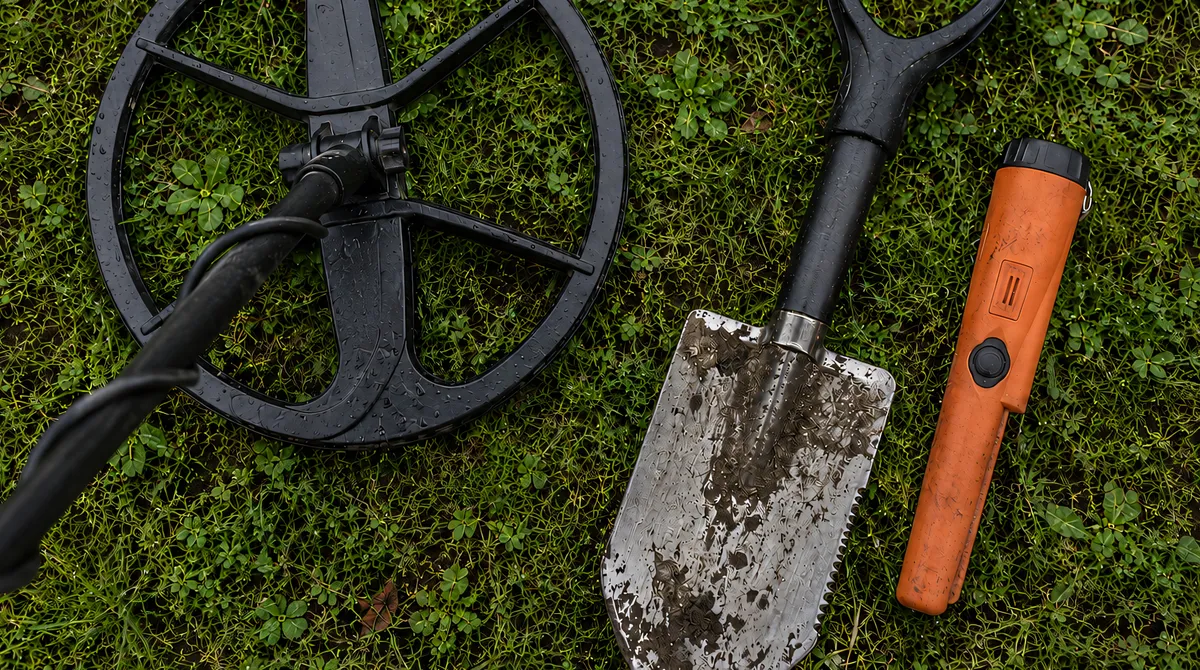
A pinpointer is the highest-value accessory in detecting, full stop. Without one, recovering a small target from a dug hole is slow and frustrating, and you will lose targets entirely. With one, recovery time drops from minutes to seconds — which directly translates into more targets per session. If money is tight, buy a cheaper detector and a pinpointer rather than a better detector and no pinpointer. Our pinpointer guide covers what to look for and how to use one properly.
A proper digging tool suited to your ground: a sturdy trowel or purpose-made digger for turf, a stainless sand scoop for beaches. A garden trowel will bend and then break.
Headphones improve target detection more than most people expect, especially the faint deep signals that a speaker in wind simply loses.
A finds pouch and a trash pouch. Two separate pouches. Carrying out your trash is the practice that keeps landowners saying yes.
Knee pads. Unglamorous and transformative.
The brands worth looking at
Three manufacturers dominate the beginner market, and all three make genuinely capable machines. Model lines change regularly, so treat this as a map of the landscape rather than a list of specific SKUs to buy — check current models before you purchase.
Minelab — the Vanquish line brought Minelab’s multi-frequency technology into the entry-level bracket, which is unusual at this price point and makes it a strong choice for anyone expecting to detect beaches as well as parks. Turn-on-and-go operation.
Nokta — the Simplex family built its reputation on being fully waterproof at an entry-level price, with a modern interface and frequent firmware updates. If waterproofing matters to you, this is the line that put it in reach.
Garrett — the ACE series is the long-standing default recommendation, and deservedly so. Single-frequency, extremely simple controls, well-supported, and a very large community of users, which means help is easy to find when you have a question.
There is no wrong answer among these. Pick based on the two or three things you actually care about — waterproofing, weight, saltwater capability — and stop researching. The time you spend agonising over the choice would be better spent in a field.
Prices vary considerably by region and change constantly, so check current pricing locally rather than trusting a figure in an article. Buying from a specialist detecting dealer rather than a general marketplace is worth a small premium for the support alone.
Where not to buy
Avoid unbranded detectors from general marketplaces. The very cheap machines with no manufacturer name behind them have poor discrimination, unreliable depth, and no support, and they are the leading cause of beginners quitting after three outings convinced there is nothing in the ground.
Be careful with used gear until you know what you are looking at. Coils fail, shafts wear, and waterproof seals degrade. A used machine from a club member is usually fine; one from a stranger with no history is a gamble.
Be sceptical of “best detector” lists — including the ones that look editorial. Most are affiliate-driven, and the rankings frequently track commission rates rather than performance.
Buy the machine, then do the work
The thing that will improve your finds fastest is not in the box.
It is knowing that the corner of the sports field near the old grandstand produces silver while the rest of it produces bottle caps. It is knowing that your machine reads a certain way over a particular kind of target in your soil. It is knowing that the paddock is worth working after rain and not worth the drive when it is baked hard.
None of that is knowledge you can buy. It accumulates from paying attention across dozens of hunts — which is exactly why detectorists who keep a logbook tend to improve faster than those relying on memory. Recording the settings you ran, the signals you got, and what came out of the ground turns each hunt into information rather than just an afternoon. Our guide to tracking detector settings covers what is worth capturing per hunt, and it works the same whether your machine has three settings or thirty.
If you are just getting started, the beginner’s guide covers the field habits, permissions, and workflow that make the machine you chose largely irrelevant. Buy something reasonable, learn it deeply, and put in the hours. That has always been the answer.
Frequently asked questions
How much should I spend on my first metal detector?
The entry-level bracket from the established brands is enough to find coins, jewellery, and relics at normal depths. Spending more buys convenience and capability, not a different class of find. Budget for a pinpointer and a proper digging tool as part of the total, because those affect your results more than the last hundred dollars of detector does.
Is a more expensive metal detector worth it for a beginner?
Usually not at first. Premium machines are more capable but have more settings to get wrong, and a beginner cannot yet tell whether a poor result came from the ground, the settings, or the technique. Learn one simple machine deeply, then upgrade knowing exactly what limitation you are paying to fix.
What is the difference between single frequency and multi-frequency detectors?
Single-frequency machines transmit at one frequency and work well in most inland soil. Multi-frequency machines transmit several at once, which handles mineralised ground and wet salt sand far better. If you plan to detect saltwater beaches regularly, multi-frequency is worth prioritising; for parks and fields it matters much less.
Keep reading
Pinpointers: Why They Matter and How to Use One
A pinpointer is the highest-value accessory in detecting. What it does, how to use one properly, what to look for when buying, and the habits that make it pay.
Digging and Recovery: Cut a Clean Plug, Leave No Trace
Recovery is the skill that decides whether you keep your permissions. Tools, plug technique by ground type, and how to get the target out undamaged.
The Responsible Beginner's Guide to Metal Detecting
Everything a new detectorist needs: choosing gear, getting permission, a simple hunt workflow, and the habits that turn you into a better hunter fast.