
Digging and Recovery: Cut a Clean Plug, Leave No Trace
Recovery is the skill that decides whether you keep your permissions. Tools, plug technique by ground type, and how to get the target out undamaged.
Everything upstream of recovery is comparatively easy. The machine finds the target, the pinpointer narrows it down, and then you have to get an object out of the ground without wrecking the ground, wrecking the object, or giving the landowner a reason to say no next time.
Recovery is the part beginners rush and experienced detectorists slow down. It is also the single most visible thing you do. Nobody sees your settings discipline. Everybody sees the hole.
Why this is the skill that keeps your access
A permission is lost in one afternoon and won back almost never.
Landowners and council staff do not evaluate you on your finds. They evaluate you on whether the paddock looks the same when you leave, whether a horse could turn an ankle in something you left behind, and whether the sportsground manager gets a complaint on Monday. A detectorist who leaves clean ground gets invited back and, more valuably, gets recommended to the neighbour.
The reverse travels faster. One scalped lawn on a council reserve is how a whole municipality ends up with a blanket ban, and everyone else in the club inherits it.
If you are still building your permissions, our guide to asking landowners properly covers the conversation — and the promise to fill every hole is the part you will be judged on.
The tools that actually matter
You do not need many, but the wrong one makes clean recovery genuinely difficult.
A serrated hand digger is the workhorse for turf, pasture and woodland. A stiff blade with a sawing edge cuts roots instead of tearing them, which is the whole difference between a plug that heals and a plug that dies. Keep the edge sharp — a blunt digger rips.
A sand scoop for dry beach sand, where a hand digger is useless. Long-handled scoops save your back over a session; hand scoops are fine if you are working the wet.
A pick for hard, rocky, mineralised ground. Goldfields country in particular will destroy a hand digger, and a lightweight prospecting pick with a magnet on the head is standard kit there.
A pinpointer. Not a digging tool, but it decides how big the hole needs to be. Without one you dig wide and hope; with one you dig once, in the right place. It is the accessory with the highest return in the whole kit, which is why we gave it its own guide.
A finds pouch and a trash pouch, separately. The trash pouch is not optional — see below.
A kneeling mat or knee pads. Unglamorous, and the reason you can still recover targets properly in hour five.
Pinpoint before you cut
The most common beginner mistake is digging at the centre of a broad signal instead of the centre of the target.
Narrow it down first. Cross the target from two directions at ninety degrees and note where the response peaks each time — the intersection is your spot, not the middle of the noisy area. Some machines have a pinpoint mode; the manual X-pattern works on anything.
Then mark it. A boot heel scuff or a small stick costs two seconds and stops you cutting a plug offset from the target and having to widen it.
The size of your hole is decided before you cut, by how well you pinpointed. Everything after that is execution.
Cutting a plug in turf and pasture
This is the technique that matters most, because it is the ground where damage shows.
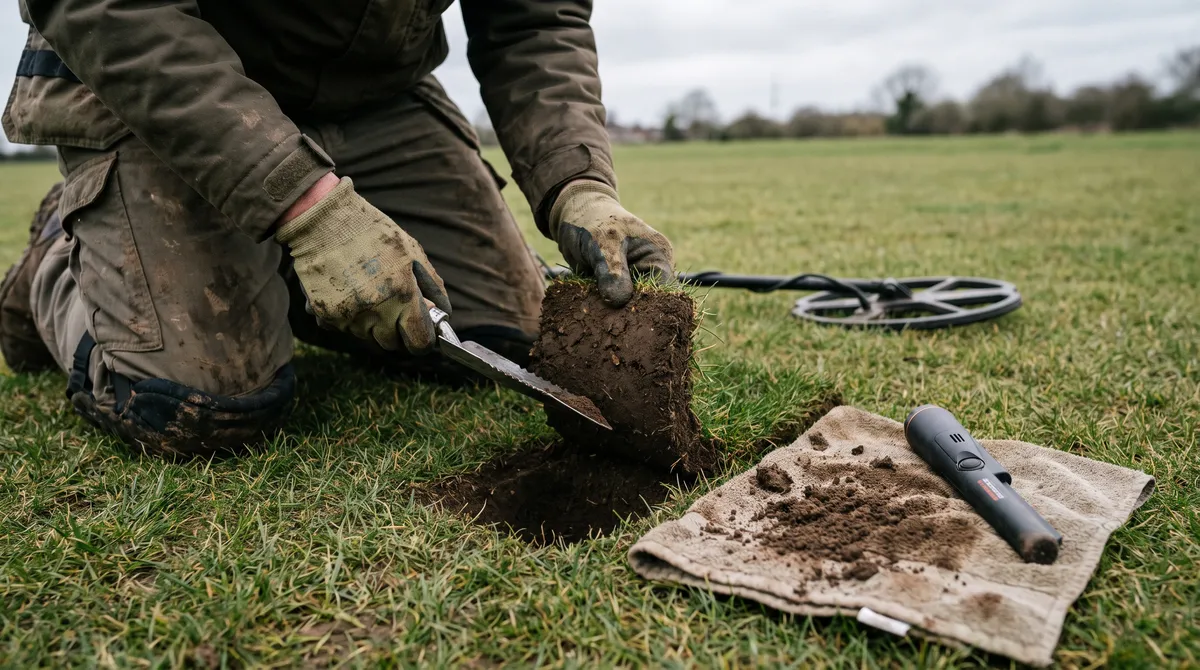
Cut a U, not an O. Push the digger in vertically and cut three sides of a square or a horseshoe, leaving the fourth side uncut as a hinge. That hinge keeps the turf’s root connection intact, which is what lets it survive. A fully detached circular plug is a disc of dying grass sitting in a hole.
Go deep enough to take the roots. Around 100mm. A shallow cut shears the root mass off and the plug browns off within days no matter how neatly you replace it.
Fold it back, do not lift it out. Hinge the plug over onto the grass beside the hole, keeping it turf-side up and intact.
Put the loose soil somewhere retrievable. A small mat, a piece of canvas, or even the inside of your finds pouch flap. Soil scattered into grass is soil you cannot get back into the hole, and the difference between a plug that sits flush and one that leaves a dip.
Check the hole, then check the pile. Sweep the pinpointer over the hole; if the target is not there it is in the spoil. Spread the pile thin rather than digging deeper into ground that no longer holds anything.
Replace, press, and check from standing. Fold the plug back, press it down firmly with your boot until it is flush or very slightly proud, and scuff any loose crumbs back into the seam. Then stand up and look at it from head height. If you can see it from standing, it is not finished.
Done properly on healthy turf, a plug is invisible within a week and completely gone within a fortnight.
Adjusting for the ground you are on
Dry sand does not hold a plug at all. Scoop it, sift the target out in the scoop basket, and backfill by pushing the surrounding sand in with your boot. Leave no open holes on a beach — they are a genuine ankle hazard and the fastest route to a council complaint.
Wet sand collapses as you dig and the hole fills with water. Work faster, use the scoop to lift and sift in one motion, and expect to re-pinpoint after the first scoop because the target moves with the slurry. Our beach detecting guide covers the rest of the coastal problem.
Ploughed and cropped fields are the easy case — there is no turf to preserve, the ground is already disturbed, and you can simply dig and backfill. Still fill the hole. Livestock and machinery both find holes.
Woodland and leaf litter. Set the litter aside as a layer, cut beneath it, and put the litter back on top afterwards. It restores the appearance almost completely.
Hard mineralised goldfields ground is a pick job, and it is the one place where a wider hole is often unavoidable. Backfill it properly anyway, and mound it slightly to allow for settling. Old workings country has enough holes in it already, and adding to them is exactly what gets prospecting access reviewed — see our Victorian guide for how tightly that ground is watched.
Getting the target out undamaged
A recovered coin that you have put a fresh gouge across has lost most of its interest and much of its value.
Never dig straight down onto a target. Cut around it and come in from the side.
Once you are close, stop using metal. Loosen soil with the tool, then work the last of it with your fingers. Most damage happens in the final few centimetres, when people are impatient and the target is right there.
Do not scrape mud off with the blade. Whatever is under that dirt is softer than your digger. Silver and copper mark instantly.
Bag it, do not pocket it. A pocket full of finds rubbing together does its own damage, and a shared pocket is how a good coin gets scratched by a piece of scrap. What you do next matters too — most of the harm done to detecting finds happens after recovery, not during, which is the subject of our guide to cleaning finds without ruining them.
Take the trash out
Every piece of junk you dig should leave the site with you. This is partly courtesy and partly self-interest.
The courtesy is obvious: you are removing broken glass, ring pulls, shotgun cartridges and wire from someone’s paddock, and landowners notice. It is the cheapest goodwill available to you.
The self-interest is that clearing trash makes the site better every time you visit. A patch you have cleaned is a patch where the next signal is more likely to be worth digging — the compounding effect behind improving your keeper rate.
Carry a dedicated trash pouch so junk never mixes with finds, and empty it in your own bin rather than the landowner’s.
Record what the ground was like
Recovery notes are the ones people skip and later wish they had.
How deep the target sat, what the soil was doing, whether the ground was wet or baked, whether the plug held — all of that explains your results later. A site that produced nothing in February and well in July usually differed in ground conditions rather than in luck, and depth records tell you whether you are reaching the older material or only skimming modern loss.
Noting it alongside the find and the GPS pin in your logbook turns a vague impression into something you can actually act on next season.
Dig slowly, dig small, and leave the ground looking untouched. It is the least glamorous skill in detecting and the one that decides how much ground you still have access to in five years.
Frequently asked questions
How do you dig a plug without damaging the lawn?
Cut a U-shape rather than a full circle, leaving one side attached as a hinge so the turf keeps its root connection and water supply. Cut deep enough to take the roots with it — around 100mm — fold it back rather than lifting it out, keep the loose soil on a mat, and firm the plug down with your boot when you replace it. Done properly it is invisible within a week.
What is the best digging tool for metal detecting?
For turf and pasture, a serrated hand digger with a sharpened edge is the standard and does almost everything. Dry beach sand needs a scoop. Hard, rocky goldfields ground needs a pick. Most detectorists end up with two tools rather than one perfect one, because the ground varies more than any single blade can handle.
How deep should you dig a signal?
Only as deep as the signal requires. Recheck with the detector or a pinpointer after every few centimetres rather than digging to a fixed depth. Most park and pasture targets sit in the top 150mm, and digging past the target wastes time and does damage you did not need to do.
Keep reading
Pinpointers: Why They Matter and How to Use One
A pinpointer is the highest-value accessory in detecting. What it does, how to use one properly, what to look for when buying, and the habits that make it pay.
Choosing Your First Metal Detector: An Honest Buying Guide
What actually matters in a first metal detector, which specs are marketing noise, and why the accessories you skip cost you more finds than the machine you pick.
Trash vs Treasure: Improve Your Keeper Rate Over Time
Digging junk is part of detecting — but patterns can cut the wasted digging. Here is how to raise your keeper rate without missing the good finds.