
How to Ask a Landowner for Metal Detecting Permission
A respectful, proven approach to getting metal detecting permission — what to say, what to offer, how to handle no, and what to put in writing.
Updated
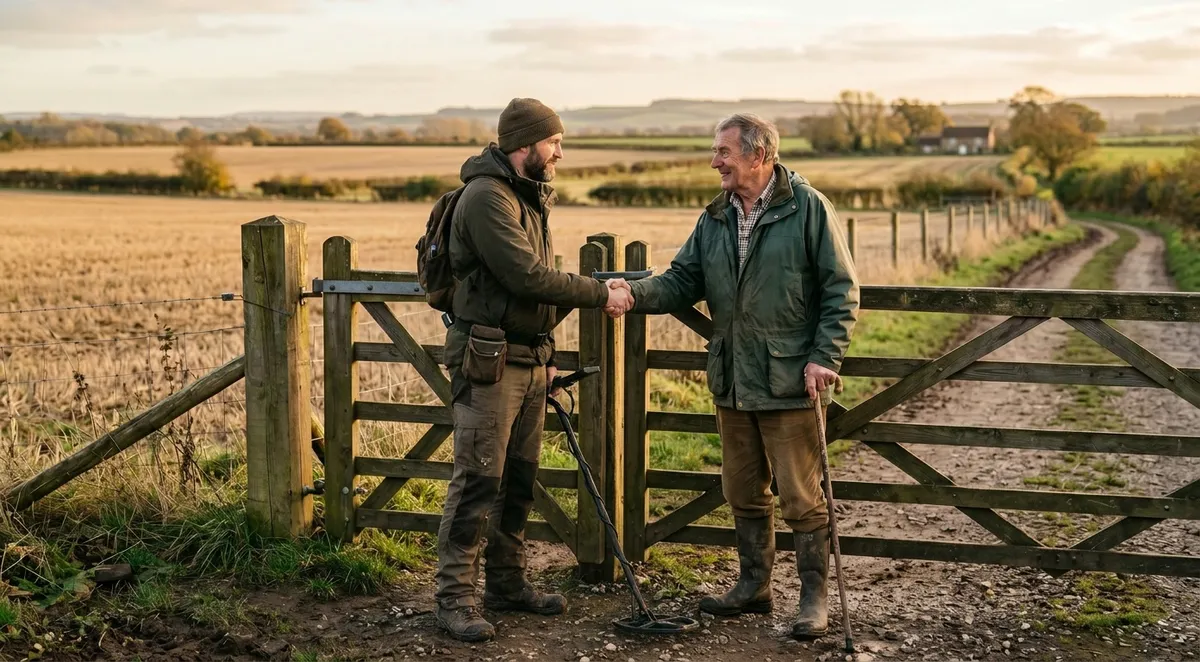
Getting permission is mostly about making it easy for someone to say yes. Landowners don’t say no because they hate metal detecting. They say no because they don’t know you, they picture a field full of holes, and they’re not sure what’s in it for them. Address those three things and your hit rate goes way up.
Here’s how to ask well.
Do a little homework first
Five minutes before you knock changes the conversation considerably.
Know which land you are asking about. “One of your fields” is vague; “the field at the top of Mill Lane, behind the barn” shows you have thought about it and makes the decision concrete.
Find out who actually owns it. The person farming a field is often a tenant. Ask them, and if the owner is someone else, get the owner’s agreement too — a tenant’s yes will not protect you if the owner objects.
Check whether the ground is protected before you ask, not after. Turning up already knowing there is a scheduled monument in the corner you will be avoiding is remarkably persuasive. Our check-before-you-dig framework covers what to look for.
Make a good first impression
Approach in person when you can — it’s far harder to say no to a friendly face than an email. Knock at a reasonable hour, dress tidily, and lead with who you are and what you’d like to do. Keep it relaxed. You’re asking for a small favour, not negotiating a contract.
A simple opener works:
“Hi, I’m [name], I live locally. I’m a hobby metal detectorist and I was wondering if you’d ever consider letting me search one of your fields. I always fill my holes, take any rubbish away, and I’m happy to show you anything I find.”
That’s it. Short, honest, and it answers their main worries before they ask.
Timing matters more than people think. Farms have busy seasons and busy hours. Turning up during harvest, at first light, or in the middle of lambing marks you as someone who does not understand how the place works. Mid-morning or early evening, outside the peak periods, gets you a conversation rather than a brush-off.
Go to the right door. On a working farm the house is often not where business happens — the yard, the office, or whoever is visibly working may be the right approach. And do not walk across land to reach someone; use the drive.
Explain the hobby without overselling
Most people are curious once they realise you’re not treasure-hunting for profit. Explain that you’re looking for old coins, buttons, and bits of history, and that most of what you dig is small and modern. Don’t promise riches. Don’t talk like you expect to find gold. Calm and modest beats excited and grand.
Offer real value
Give them a reason beyond “because I’d like to.” A few that land well:
- You’ll clear their land of metal trash — old nails, wire, and junk that can harm livestock or machinery.
- You’ll share or return anything meaningful you find on their property.
- You’ll show them photos of the interesting bits and the story behind them.
- You’ll report anything potentially historic so it’s recorded properly.
Many landowners enjoy seeing what comes out of ground their family has worked for generations. That’s the real draw.
Address the worries up front
Say these things before they have to:
- Holes: “I cut a neat plug and put it back so the grass recovers — you won’t see where I’ve been.”
- Rubbish: “Anything I dig that’s junk, I take with me.”
- Their land, their rules: “Just tell me anywhere you’d rather I stayed off — livestock, crops, anything sensitive.”
- Insurance: if you’re in a detecting club with liability cover, mention it. It reassures.
The objections you will actually hear
Most refusals come in a handful of recognisable shapes, and none of them need arguing with.
“You’ll leave the field full of holes.” The most common, and the most answerable. Offer to demonstrate: dig one plug in front of them and put it back. Thirty seconds of showing beats any amount of promising — provided you can actually cut a clean plug, which is a skill worth practising before you need it in front of someone. Our guide to digging and recovery covers the technique.
“What if you find something valuable?” They are usually not being greedy — they are worried about an awkward situation later. Say plainly that anything of value is theirs as much as yours, that you would agree a split in writing beforehand, and that legally significant finds get reported properly regardless.
“What if you hurt yourself?” This is a liability worry. Club membership with public liability insurance answers it completely, which is one of the better arguments for joining one.
“I’ve had detectorists before and they were a nuisance.” Do not defend the hobby or the previous person. Acknowledge it, say that is exactly the behaviour that gives detecting a bad name, and offer a single trial visit they can judge you on.
“I’ll think about it.” Usually a polite no, occasionally genuine. Leave your number, thank them, and do not chase. If they meant it, they will call.
Sort the finds agreement early
Awkward later, easy now. Agree up front who keeps what. A common arrangement is a 50/50 split on anything of value, with the landowner keeping the right to anything found on their property by law. Most finds are worth little, so this rarely comes up — but having the conversation once, calmly, prevents a bad one down the track.
Put it in writing
A handshake is a start. A short written note is better. Even a text that says “Happy for you to detect the back paddock through summer, usual agreement on finds” gives you something to point to. Keep a copy.
If you want something more complete, a written agreement is worth keeping to a single page and covering only:
- Who — your name and contact details, and theirs.
- Where — which fields or areas, and any explicitly excluded.
- When — the period it covers, and any seasonal restrictions.
- Finds — the agreed split, and confirmation that reportable finds will be reported.
- Conduct — filling holes, removing rubbish, closing gates, no third parties without asking.
- Either party can end it — which reassures them far more than a binding-sounding document would.
Anything longer starts to look like a contract and makes a friendly arrangement feel like a legal one, which is not the impression you want.
This is exactly the kind of detail worth storing properly rather than trusting to memory. Keep the written agreement somewhere you can reach it in the field — a photo of the note on your phone does the job — and put the conditions the owner asked for into your hunt notes in DetectingLog, so what you agreed sits with the record of the hunts you did there. Pair that with keeping your sites private and you’re covered.
It is a numbers game
Set your expectations properly and the whole process gets much easier to sustain.
Most people will say no, and it usually has nothing to do with you. They are busy, or cautious, or have had a bad experience, or simply do not want a stranger on their land. Ten polite approaches yielding one or two yeses is a perfectly ordinary rate.
The compounding effect is what matters. Rural communities are small and interconnected. One landowner who is happy with you will mention you to a neighbour, and a recommendation is worth twenty cold approaches. Almost every detectorist with good access built it from one or two initial yeses that multiplied.
So keep asking, keep records of who you asked and what they said, and revisit a “not right now” after a season. Access is cumulative.
When the answer’s no
Say thanks, leave a card or your number, and go. Don’t argue, don’t sulk, and absolutely never detect anyway. Rural communities talk. The detectorist who took “no” gracefully is the one who gets the call when the owner changes their mind — or when their neighbour’s looking for someone trustworthy.
Keeping a permission is harder than getting one
Getting the yes is the easy part. Losing it is easier still, and it is almost always behaviour rather than bad luck.
The things that end permissions: leaving holes, leaving gates open, bringing friends without asking, turning up unannounced during a busy period, walking a growing crop, going quiet and never showing them anything, and — the fastest of all — telling other people where the site is.
The things that keep them: filling every hole properly, carrying out every scrap of rubbish, texting before you come, respecting the areas they asked you to avoid, and showing them what you find. Take them a photograph and a short story about an object from their land and you become a small pleasure in their year rather than an imposition.
Know the rules before you knock
Permission from the landowner is necessary but not always sufficient. Protected sites, heritage listings, and reporting obligations sit on top of whatever the owner agrees to, and they vary enormously by jurisdiction — see our guides to the rules in the UK and Australia, or the general check-before-you-dig framework. Turning up already knowing what applies also makes you look like someone worth saying yes to.
After the hunt: close the loop
Permission isn’t a one-time transaction. Send a quick thank-you and a photo or two of anything interesting. Offer to show them the finds you documented. That goodwill turns one yes into a standing invitation — and often introductions to other landowners nearby.
If something you find turns out to be genuinely old, telling them you are having it recorded properly tends to delight rather than alarm. Most landowners are far more interested in the history of their own ground than in its value.
Keep each landowner’s conditions in your hunt notes, privately.
Frequently asked questions
What should I say when asking for metal detecting permission?
Keep it short and respectful. Introduce yourself, explain the hobby briefly, promise to fill every hole and remove all trash, and offer to share what you find. Mention you'll work around livestock, crops, and any areas they'd rather you avoid. Make it easy to say yes.
How many landowners do I need to ask to get a permission?
Expect most to say no, and do not read anything into it. Detectorists who build good access treat it as a numbers game — ten polite approaches producing one or two yeses is a perfectly normal rate, and the yeses tend to lead to further introductions.
Should metal detecting permission be in writing?
Yes, when you can. A simple written note — even a text or email — confirming you have permission, the dates, and any finds agreement protects both you and the landowner. Keep a copy so you can prove access if anyone asks.
How do I handle a landowner saying no?
Thank them, leave your contact details, and move on graciously. A polite no today can become a yes later, and word travels in farming and rural communities. Never push, and never detect anyway — that ruins it for everyone.
Keep reading
Miner's Right Victoria: Cost, How to Get One and the Rules
A Victorian Miner's Right costs $29.40 for 10 years, rising to $41.40 on 1 January 2027. How to buy one, what it lets you do, and the rules attached.
Metal Detecting in the Northern Territory: Permit and Land Access
The NT has required a fossicking permit since June 2026. How the free permit, fossicking notices, pastoral land, Aboriginal land and gold limits work.
Metal Detecting in South Australia: No Permit, Always Permission
South Australia needs no fossicking permit, but every block needs someone's consent. How Crown land, parks, Jupiter Creek and Mount Crawford work.