
Beach Metal Detecting: Tides, Salt, and Settings
Beaches hide gold but punish the unprepared. How to read tides and sand zones, stop salt from wrecking your signals, and protect your gear from corrosion.
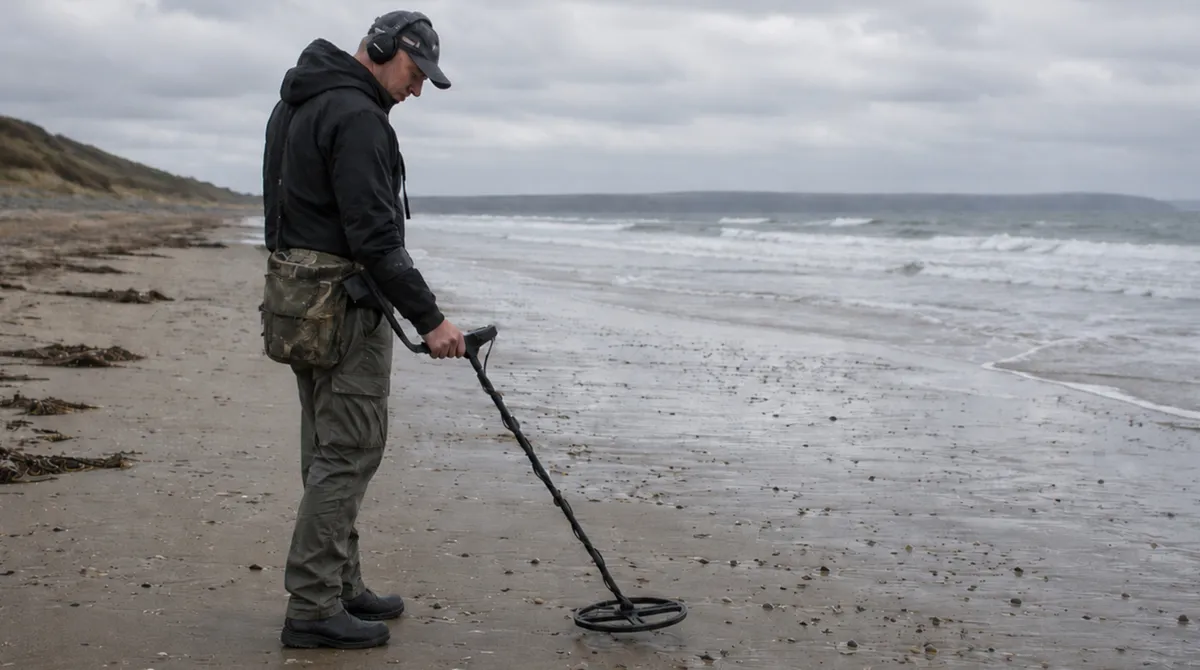
Beaches are the most rewarding and most frustrating ground most detectorists ever work.
Rewarding because the sand is constantly being reloaded. Every summer weekend deposits fresh rings, chains, and coins, and every storm redistributes decades of them. Beaches are one of the few places where the supply genuinely renews itself.
Frustrating because salt water turns an otherwise well-behaved detector into a screaming mess, the ground moves under your feet between visits, and the sea will destroy your equipment given the slightest opening.
Here is how to work them properly.
The tide is the whole game
On a beach, timing beats technique.
Work low tide. The two hours either side of low water give you access to ground that spends most of its life submerged — which is exactly the ground that has been collecting losses without being detected. Check a tide table before you go, not after.
Prefer spring tides. Around the new and full moon, the tidal range is at its greatest and low water goes further out than usual. Spring low tides expose ground that neap tides never uncover, and that ground sees far less detecting pressure as a result.
Go after storms. This is the single biggest edge available to a beach detectorist. Heavy surf strips sand off a beach and can cut down through years of accumulation, briefly exposing older layers and the heavier items that had settled into them. A beach after a big blow is a different site to the same beach in calm weather.
The corollary is that a beach can also fill. Calm summer conditions pile sand back on, sometimes burying productive ground under a metre of fresh material. If a beach that produced well last month is dead now, the finds have not gone — they are just out of reach.
This is why a beach is worth logging carefully. The state of the sand is as important as the location, and it is the detail memory loses first. Recording conditions per visit is exactly what the hunt planner approach is for.
Reading the zones
A beach is not one site. It is several, and they behave differently.
Dry sand (the towel line). Above the high-water mark, where people sit, sleep, and apply sunscreen. This is where jewellery comes off — cold fingers shrink, sunscreen makes rings slip, and things fall out of pockets. Losses here are recent and shallow. It is also the easiest ground to detect, because dry sand carries almost no salt conductivity, so a standard VLF machine behaves normally.
Wet sand (the intertidal zone). Between high and low water. This is where the electronics get tested and where older material concentrates, because water movement sorts items by density and works heavy things downward over time.
The surf and shallow water. The hardest and often the most productive zone, for the obvious reason that fewer people detect it. Requires genuinely waterproof gear and real care about your own safety.
Cuts and scarps. After erosion, a beach can develop a small vertical step where sand has been stripped away. The base of a cut is a classic hotspot — heavy items work along and settle at these features. Find a fresh cut and work it before it fills.
Troughs and low points. Depressions in the wet sand collect heavy objects the way a riffle collects gold. Worth a slow, deliberate pass.
Why salt breaks your detector
Salt water is conductive. To a single-frequency VLF detector, wet salt sand is not neutral ground — it is an enormous, diffuse conductive target spread under your coil, and the machine responds accordingly with constant falsing, chatter, and unusable depth.
There are three ways around it.
Ground balance for salt. Many mid-range and better VLF detectors have a salt or beach mode, or allow manual ground balancing that can be tuned to compensate. This works, up to a point, and needs redoing as you move between wet and dry sand.
Drop sensitivity. Counterintuitive but effective. Running a lower sensitivity setting in wet salt sand often gives you more usable depth than running high sensitivity and fighting constant falsing. A stable machine at moderate sensitivity beats an unstable one at maximum.
Use the right machine. Multi-frequency VLF detectors handle salt far better than single-frequency, because processing several frequencies simultaneously lets them separate the ground signal from real targets. Pulse induction detectors largely ignore ground conductivity altogether, which makes them exceptional in salt water and on black sand — at the cost of poor discrimination, meaning you will dig a great deal of iron and bottle caps.
For jewellery hunting specifically, PI’s weak discrimination matters less than you would think. Gold reads low and close to trash on most machines anyway, so a beach hunter chasing rings is going to be digging low tones regardless.
Whatever you run, expect your settings to differ from your inland setup, and expect them to differ between the dry and wet zones of the same beach. This is precisely the situation where logging settings per hunt pays for itself, as covered in our guide to tracking detector settings.
Black sand and mineralisation
Some beaches carry heavy concentrations of magnetite — fine black sand, often visible as dark streaks and layers in the wet zone.
It is highly magnetic and it wrecks VLF performance, sometimes worse than the salt does. If you can see distinct black layers and your machine is struggling despite a good salt balance, mineralisation is the likely culprit. PI machines handle it comfortably; VLF machines need sensitivity reduced and expectations lowered.
Note it in your log when you see it. Black sand is patchy and it tends to reappear in the same parts of the same beaches, which makes it a predictable feature rather than a mystery once you have a few visits recorded.
What beaches actually produce
Gold rings and jewellery are the headline. Cold water shrinks fingers, sunscreen and oil make rings slide, and losses accumulate in the water and along the towel line.
Coins in volume, mostly modern, mostly shallow, mostly in the dry sand.
Older material in the wet zone and around cuts, where sorting works heavy objects down and time works them along.
A remarkable quantity of trash. Bottle caps, pull tabs, foil, fishing weights, and hair clips, all of which read in similar ranges to gold. This is not avoidable. Improving your keeper rate on a beach is mostly about learning the specific trash signature of that beach rather than about better discrimination.
Protecting your gear
Salt water is corrosive and relentless, and it gets into everything.
Rinse everything in fresh water after every single session — detector, coil, shaft, headphones, pinpointer, digging tools, scoop, and the pouch. Not “when you remember.” Every time.
Dry it fully before storing. Trapped salt water in a shaft joint or a battery compartment causes damage that only becomes apparent when something fails in the field.
Check your waterproof rating before you go anywhere near water. Many detectors have waterproof coils but a control box that is only splash-resistant. Submerging the wrong machine is a fast and expensive mistake, and it is not covered by warranty.
Use a sand scoop. A stainless or titanium scoop with drainage holes is essential in wet sand — a trowel simply does not work, and plastic scoops break.
Bring the pinpointer, and tether it. Recovering a small target in loose sand without a pinpointer is genuinely difficult. Recovering a dropped pinpointer from wet sand is worse.
Safety and access
Beaches are more hazardous than they look, and the hazards are the kind that catch out experienced people.
Know the incoming tide. Being cut off by a rising tide against a cliff or a headland is the classic beach detecting accident. Know your exit before you commit to a stretch of ground.
Respect rips and currents. If you are working the surf, know the beach and do not work alone in unfamiliar water.
Watch for soft sand and mud around estuaries and river mouths, which can be genuinely dangerous.
Check the rules. Beach access for detecting is not universally permitted. Many beaches are managed by a council, national park authority, or crown land body, and rules can differ between the dry sand, the wet sand, and protected dune systems — sometimes on the same beach. Marine parks and heritage-listed foreshores often prohibit detecting outright. Our legal checklist walks through how to find out who manages a given piece of ground and what they allow.
Fill your holes, especially in the dry sand where people walk barefoot. Nothing loses beach access faster than a complaint about holes — our digging and recovery guide covers scoop technique and how wet sand changes it.
Storms are the opportunity
One weather event matters more than all the rest. Heavy onshore surf strips sand off a beach rather than adding it, exposing older layers where years of lost rings and coins have settled — and then the sand returns over the following weeks and buries it again.
That short window is the closest thing to a reliable edge in beach detecting, and knowing how to read a scoured beach is a skill of its own. Our guide to beach detecting after a storm covers spotting cuts, troughs and hard bottom, and how soon to go.
Log it, because beaches change
Inland sites are broadly stable. Beaches are not.
The same stretch of sand can be productive one week and buried the next, and the variable driving that is a combination of tide state, recent weather, and where the sand happens to be sitting. None of it is memorable after the fact, which means none of it is learnable unless you write it down.
Record the tide state and rough time relative to low water, recent weather and any storms, which zone you worked, whether there was a cut or trough, the settings you ran, and what came out. Do that for a season and the beach stops being random. You start to see that a particular corner produces after a southerly blow, or that the trough at the northern end is worth working on spring lows and not otherwise.
That is the whole argument for keeping a detecting logbook, and beaches make the case better than any other ground. Drop a GPS pin on the productive spots, because a featureless beach at low tide gives you nothing to navigate by — and next time the sand has moved, the pin is the only thing that has not.
Frequently asked questions
What is the best time to metal detect on a beach?
The couple of hours either side of low tide, and the lower the tide the better. Spring tides around the new and full moon expose ground that is normally underwater. The best conditions of all follow a storm, when heavy surf has stripped sand away and uncovered older, deeper layers.
Why does my metal detector go crazy on wet sand?
Salt water conducts electricity, so wet salt sand reads as a huge conductive target and overwhelms a standard single-frequency VLF detector. The fixes are to ground balance for salt, reduce sensitivity, or use a multi-frequency or pulse induction machine built for saltwater conditions.
Can I use any metal detector on the beach?
On dry sand, yes — almost anything works. On wet salt sand and in the surf you need either a multi-frequency VLF or a pulse induction detector, plus a genuinely waterproof coil. Check your machine's waterproof rating before it gets near the water, since coil-only ratings are common.
Keep reading
Beach Detecting After a Storm: Reading Sand Movement
Storms strip sand and expose years of lost jewellery. Here is how to read cuts, scallops and black sand, when to go, and how to work a scoured beach safely.
Metal Detecting the Australian Goldfields: A Field Guide
Where Australia's gold country is, why nugget hunting needs different gear and technique, how to read old diggings, and the safety that actually matters out there.
Planning a Better Metal Detecting Hunt
Weather, soil, tides, access, and safety — plan your hunt before you leave home to waste fewer trips and dig more. A practical pre-hunt checklist.