Trash vs Treasure: Improve Your Keeper Rate Over Time
Digging junk is part of detecting — but patterns can cut the wasted digging. Here is how to raise your keeper rate without missing the good finds.
Updated
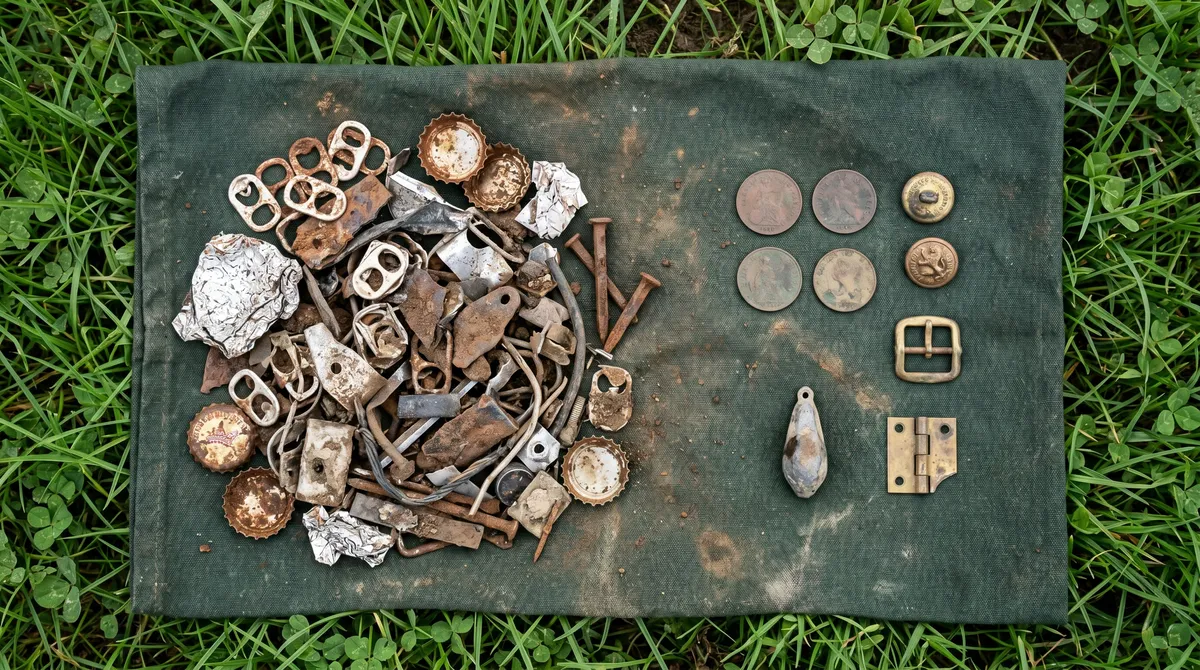
Every detectorist digs trash. Pull-tabs, bottle caps, shotgun shells, endless rusty nails — it’s the tax you pay for the good finds. But here’s what separates a frustrating hunt from a productive one: you can’t eliminate the junk, yet you can absolutely dig less of it over time. The tool for that isn’t a better detector. It’s better information about your own sites.
Junk is part of the deal — accept it, then reduce it
First, the mindset. If you’re digging trash, your detector’s working and you’re covering ground. That’s normal. The goal isn’t zero junk; it’s a steadily improving ratio of keepers to digs at the sites you hunt. Chasing zero trash usually means cranking discrimination so high you skip gold — which is the opposite of what you want.
So aim to dig smarter, not less.
Decide what a “keeper” actually is
Before the number means anything, you have to be consistent about what you are counting. This sounds pedantic. It is the difference between a metric that improves your hunting and one that just drifts around.
Pick a definition and hold to it. Most detectorists settle on something like: anything you would still want in a year. Coins, jewellery, buttons, buckles, musket balls, anything with age or a story. Not modern small change you would have picked up off the pavement anyway, and not “interesting” scrap you will throw out next month.
The trap is that the definition quietly loosens on a bad day. You dig forty signals, find nothing, and a corroded bit of harness brass starts looking like a keeper. Log it as one and you have not raised your keeper rate — you have lowered the standard while the number went up, which is worse than useless because now you cannot trust your own history.
Write your definition down once. Apply it on good days and bad ones alike.
What “keeper rate” really tells you
Your keeper rate is simply the share of your digs that turn out to be worth keeping. On its own, a single number means little. In context, it’s powerful:
- Compared across your sites, it shows which permissions are actually worth your time.
- Tracked over time at one site, it shows whether you’re getting better at reading it.
- Sliced by VDI or depth, it shows which signals are worth backing.
A low keeper rate at a trashy park isn’t failure — it’s information. Maybe that site needs a different approach, or maybe your time’s better spent elsewhere. You only know if you’re measuring.
Working it out
The arithmetic is trivial. Keepers divided by total targets recovered.
Dig sixty targets across a morning and come home with nine you would keep, and that is a keeper rate of fifteen percent. Same site a month later: fifty digs, eleven keepers, twenty-two percent. That improvement is the interesting part — not the raw figure.
Two rules make the number honest:
Count recovered targets, not signals. A signal you swung over and skipped is a judgement call, not a dig. Mixing the two means your rate improves every time you get more cautious, which tells you nothing about whether you got better.
Keep it per site. Averaging a clean rural permission together with a rubbish-strewn park produces a number that describes neither. Site-level rates are what actually inform decisions.
Don’t benchmark against other people
You will see keeper-rate figures quoted in forums and videos. Ignore them.
The number depends almost entirely on where someone hunts, and only slightly on how good they are. A detectorist working virgin farmland can post a rate that would be physically impossible on a Victorian-era public park, and it says nothing at all about their skill. Someone hunting a beach for gold rings will show a dismal rate by definition, because separating rings from pull tabs is the whole difficulty of that game.
The only meaningful comparison is you against yourself, at the same site, over time. That comparison is genuinely informative. Every other one is noise.
The factors that drive it
Whether a signal becomes a keeper depends on a stack of things you can actually track:
- VDI range — which numbers produce keepers here versus junk. See the VDI guide.
- Depth — are your keepers shallow, or are you missing deeper ones?
- Soil and weather — conditions shift both detection and what’s recoverable.
- Detector settings — covered in the settings guide.
- The site itself — some ground is just richer than others.
Log these against your keeper flag and the junk patterns of each site start to reveal themselves. You’ll learn that 33 at this park is almost always a pull-tab, while at that field it’s worth a look.
The four levers you actually control
Most advice on this subject is about discrimination settings, which is the lever with the worst risk-to-reward ratio. These four matter more.
Coverage. Slow down and overlap your sweeps. A detectorist covering a quarter of an acre properly will out-find one who half-covered two acres, because most missed targets were never under the coil in the first place. Overlapping each swing by roughly half a coil width costs time and finds things.
Recovery. A target you cannot get out of the ground is not a keeper, however good the signal was. Small, deep, and awkward targets are where a pinpointer stops being a convenience and starts being the difference between a find and a filled-in hole. This is the single biggest reason we push pinpointers so hard in the buying guide.
Judgement. The dig-or-skip call, informed by what that site has actually produced. This is the lever your logbook sharpens, and it is the only one that improves indefinitely.
Site selection. The largest effect of all, and the most under-used. Nothing you do with settings will make a barren site productive. Choosing better ground beats optimising on bad ground every single time — which is what the hunt planner is really for.
The over-filtering trap
Here’s the warning every guide should give and most don’t: the more aggressively you filter, the more good finds you miss. Gold rings, small jewellery, and low-conductive treasures live right in the same signal range as foil and tabs. Discriminate that range out to save yourself some digging, and you’ll walk straight over the finds you’d most want.
The answer isn’t heavier filtering. It’s better judgement — built from data about what that specific range actually produces at that specific site.
There is a useful asymmetry to remember here. Digging a pull tab costs you ninety seconds. Skipping the one gold ring of the year costs you the year. Those two mistakes are not equivalent, and your dig-or-skip threshold should reflect that rather than treating both as errors of the same size.
Clearing trash is an investment
Here is the part that makes the grind feel less pointless: every piece of junk you carry out is gone permanently.
Trash does not just waste your time on the day. It masks. A nail sitting beside a coin can hide that coin entirely, and a dense scatter of foil makes a whole area unreadable. Clear it and the site is genuinely, measurably better the next time you walk it — quieter, easier to read, and with targets audible that were previously buried in the noise.
This is why detectorists who work the same permission for years often report their keeper rate climbing steadily. They are not just getting better. They have been improving the ground itself, one bottle cap at a time.
It also happens to be the practice that keeps you welcome. A landowner who watches you leave with a pouch of their rubbish is a landowner who says yes next season, as covered in the permission guide — and it works best paired with the tidy recovery habits that leave the ground looking untouched.
Beaches are their own trash problem
Beach hunting deserves a warning here. Bottle caps, pull tabs, foil, and fishing weights all read in a similar range to gold, and no amount of discrimination separates them cleanly — which means a beach hunter chasing rings is going to be digging low tones regardless. Raising your keeper rate there is about learning that specific beach’s trash signature rather than filtering harder, as covered in our beach detecting guide.
Knowing when to walk away
Sometimes the data tells you something you did not want to hear.
If a site’s keeper rate has been falling across several visits and the finds have thinned out, you have probably worked it. That is not failure — it is a site reaching its natural end, and the honest response is to rest it for a season or hand your attention to somewhere new. Grinding a hunted-out permission out of loyalty is one of the most common ways detectorists waste a summer.
The counter-signal is worth watching for too. If a site’s rate is climbing while your finds get older and deeper, you are getting better at reading it and the ground still has more to give. Stay.
Without a record, both of these look identical from inside a bad afternoon.
Turn every pull-tab into data
This reframes the whole grind. That junk signal you dug? Log it. The VDI, the depth, the fact it was trash — it all sharpens the picture. After enough hunts, DetectingLog’s analytics can show you depth-versus-keeper patterns and VDI distributions per site, so your dig-or-skip calls get sharper without you doing any maths. Your logbook quietly turns a frustrating dig into a useful one.
You’ll never love digging trash. But once it’s feeding a system that makes your next hunt better, you’ll at least stop resenting it.
Frequently asked questions
What is a good keeper rate in metal detecting?
There's no universal number — it depends heavily on the site. A trashy urban park might give a low keeper rate while a clean rural permission gives a high one. What matters is your own trend over time at comparable sites, not a benchmark against anyone else.
How do I dig less junk when metal detecting?
Learn the trash patterns of your sites by logging what you dig — the VDI ranges, depths, and metals that turn out to be junk. Over time you can make smarter dig-or-skip calls. Just don't over-filter, because gold and rings hide in the same range as trash.
Should I dig every signal?
When you're learning, yes — digging everything teaches you what your detector's signals really mean. As you build a record of what produces, you can start skipping the signals that reliably turn out to be junk at a given site, while staying cautious in the gold-and-jewellery range.
Does removing trash from a site improve future hunts?
Yes, and it is one of the few permanent improvements you can make. Every piece of junk you carry out is a signal that will never mask a real target again, so a site you have cleared gradually gets quieter and easier to read. It also keeps landowners willing to have you back.
Keep reading
Digging and Recovery: Cut a Clean Plug, Leave No Trace
Recovery is the skill that decides whether you keep your permissions. Tools, plug technique by ground type, and how to get the target out undamaged.
Metal Detector Settings Explained: Sensitivity to Ground Balance
What sensitivity, discrimination, ground balance and frequency actually do, why "best settings" lists fail, and how to find the setup your ground needs.
VDI Numbers Explained: Learn Your Detector's Signals
What VDI numbers really mean, why they shift with soil and depth, and how to build your own signal history so you dig smarter and guess less.