
Metal Detecting in Victoria: Miner's Right, Parks and Goldfields
Victoria has Australia's richest detecting ground and a dense rulebook. What a Miner's Right covers, where it stops, and how to read the goldfields.
Updated
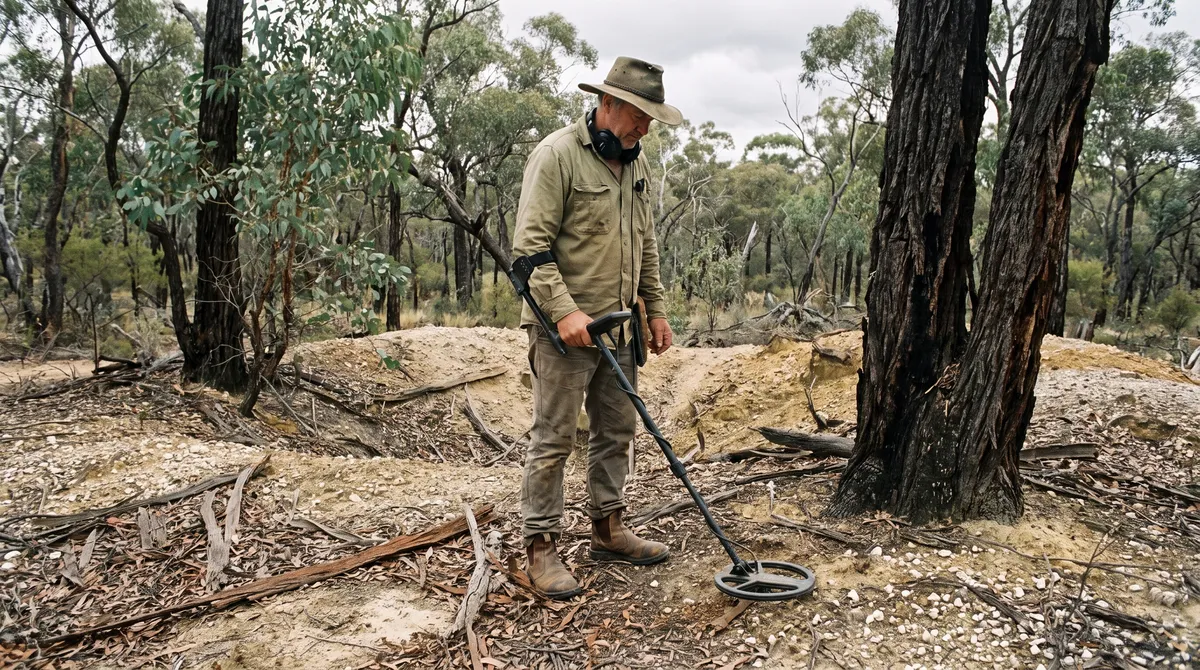
Victoria is the best metal detecting ground in Australia and, not coincidentally, some of the most closely regulated. The same history that filled the Golden Triangle with gold also filled it with protected mining relics, and the same bush that hides nuggets hides unmarked shafts.
None of that is a reason to stay home. It is a reason to know what your Miner’s Right actually covers before you leave the house, because in Victoria the gap between “legal” and “very much not legal” is often a fence line you cannot see.
This is general orientation rather than legal advice. Victorian rules change, park boundaries get redrawn, and the details of any particular block can flip the answer — check with the authority that manages the land before you dig.
For the national picture and how the states differ, start with our guide to metal detecting rules across Australia. This piece goes a level deeper on Victoria alone, and there are matching guides for NSW, Queensland, Western Australia, South Australia, Tasmania and the Northern Territory.
What a Miner’s Right actually gets you
Victoria issues a Miner’s Right under the Mineral Resources (Sustainable Development) Act 1990. It is inexpensive, runs for a multi-year term, and you apply for it through the Victorian Government’s Earth Resources division. Fees and terms change, so buy it from the official source rather than a forum link, and check the current price there rather than trusting any figure you read online — this one included. Our Miner’s Right guide covers the cost, how to buy one and the conditions attached.
What it authorises is prospecting: searching for gold, minerals and gemstones, by hand or with a detector, and taking what you find. That is the activity, and it is the one that matters in the goldfields.
What it does not do is override anything else. A Miner’s Right is permission to prospect where prospecting is allowed. It is not a defence to trespass, it does not exempt you from heritage law, and it does not open a national park. Carry it — you may be asked to produce it — but understand it as one layer of a stack rather than a universal pass.
It also does not cover coin and relic detecting on council land. Searching a foreshore reserve for dropped jewellery is not prospecting under the Act, and the permission you need there comes from the council or committee of management, not from Earth Resources.
Where the Miner’s Right applies
Three categories cover almost everything:
Crown land where prospecting is permitted. This is the backbone of Victorian detecting, and most of it is state forest. Prospecting with a Miner’s Right is broadly allowed across Victorian state forests, subject to area closures, coupe operations, and fire restrictions. It is genuinely enormous ground, and much of it sits directly over historic workings.
State forest boundaries do move, though. On 5 October 2026 about 78,800 hectares of public land in the central west and around Mirboo North passed to Parks Victoria, much of it former state forest. Prospecting is no longer allowed in the new Wombat-Lerderderg, Mount Buangor and Pyrenees national parks, which take in large parts of the old Wombat, Mount Cole and Pyrenees state forests. It is also closed in the new conservation parks and nature reserves. Parks Victoria says prospecting continues in the new bushland reserves and in six new regional parks: Bendigo, Hepburn, Barkstead, Blackwood, Fingerpost and Spargo Creek. If your maps or saved tracks predate October 2026, check them against the new boundaries. Our Miner’s Right guide lists the changes in full.
Private land, with the owner’s written consent. The Miner’s Right covers the activity; the landowner covers the access. You need both.
Designated areas within a small number of parks. Victoria carves out specific exceptions where prospecting is allowed inside otherwise-protected areas. The Castlemaine Diggings National Heritage Park is the best-known example, with defined zones open to Miner’s Right holders. These are mapped exceptions with their own conditions, and the mapping is what governs — not the general reputation of the park.
Everywhere else, assume no.
Where you cannot go
National parks, wilderness areas, reference areas and nature conservation reserves. Prospecting and ground disturbance are prohibited. Boundaries in box-ironbark country are frequently invisible on the ground — no fence, no sign, just a change on a map you did not check. This is the single most common way Victorian detectorists get themselves into trouble, and “I didn’t realise” carries no weight.
Historic mining relics. This is the Victorian trap, and it deserves its own paragraph. The Heritage Act 2017 protects historical archaeological sites and relics, and the Victorian bush is dense with them: puddling machines, stone alignments, shaft collars, water races, hut sites, mullock heaps and the scatter of iron and ceramic around old camps. These are exactly the features that look most promising to a detectorist, and disturbing them is an offence. The rule of thumb that keeps people out of trouble: if it looks like someone built it, worked it, or lived on it, leave it alone and detect elsewhere.
Aboriginal cultural heritage. Aboriginal places and objects are protected under the Aboriginal Heritage Act 2006 whether or not they are registered, marked, or obvious. Penalties are severe and ignorance is not a defence. If you encounter what may be an artefact, stop, disturb nothing further, note the location, and report it to First Peoples – State Relations. Areas of cultural heritage sensitivity are mapped, and checking that mapping is part of planning a trip, not an optional extra.
Land under an active mining licence or tenement without the holder’s consent, and water frontages and Crown land licensed to an adjoining owner without dealing with the licensee.
The Golden Triangle
The historic ground sits in a rough triangle between Ballarat, Bendigo and Wedderburn, taking in Maryborough, Dunolly, Tarnagulla, Rheola, Moliagul and Kingower. This is the country that produced the Welcome Stranger in 1869 near Moliagul — at roughly 72 kilograms gross, still the largest alluvial gold nugget ever found anywhere.
More relevant to anyone reading this: the Hand of Faith, 27.2 kilograms, was found at Kingower in 1980 with a metal detector, barely under the surface. The Triangle is not exhausted. It is worked, but the shallow ground keeps producing, because detectors keep improving and the gold that was too small or too deep for a 1980s machine is still exactly where it was.
What that means practically is that ground others have walked is still worth walking. Slower coil speed, better ground balance and a modern machine pull targets out of dirt that has been detected for four decades.
Our Australian goldfields field guide covers how to read old workings, why alluvial and reef gold sit in different places, and what a general-purpose detector struggles with in this country.
The ground will fight your machine
Victorian goldfields soil is mineralised, often heavily, and it is full of hot rocks. A detector that runs beautifully in a Melbourne park will scream in Wedderburn.
Three things matter more here than almost anywhere else:
Ground balance. Not once at the car — repeatedly, through the day, as the soil changes. In this country the difference between a balanced machine and an unbalanced one is the difference between hearing small gold and hearing nothing but noise.
Sensitivity discipline. The correct setting is the highest one that stays stable on the ground you are standing on, which will be well below maximum. Chasing depth with a sensitivity setting the soil cannot support makes the machine less capable, not more.
Target ID scepticism. Small gold reads low, in the same range as foil and iron, and mineralisation drags numbers around further still. Digging everything is slower and it is also how nuggets get found. Our guides to detector settings and VDI numbers go into both problems properly.
Log what you ran and where. Mineralisation varies enormously across the Triangle, and the settings that worked at Rheola are a starting point rather than an answer at Tarnagulla.
Beaches, parks and council land
Away from the goldfields, Victorian detecting means the bay and the coast — Port Phillip, Western Port, the Surf Coast, the Mornington Peninsula — plus local parks and sportsgrounds.
None of that is Miner’s Right territory. It is governed by whichever council or committee of management controls the reserve, and Victorian councils take genuinely different positions. Some permit detecting freely, some require a permit, some restrict it to certain hours or to dry sand only, and some say no outright. Neighbouring councils regularly disagree.
Ask the specific council’s open space or foreshore team, in writing if you can, and keep the reply. Dune systems are frequently protected for erosion control independently of anything else, and coastal reserves can sit under state rather than council management.
Our check-before-you-dig checklist sets out the general framework, and beach detecting covers the technical side — salt, tides and the settings that make wet sand workable.
Private land is still the best ground
Victorian farmland sees almost no detecting pressure, and old homestead sites, stock camps, and the ground around former hotels and coach stops carry a century and a half of dropped material.
The permission conversation is the same as anywhere: be direct, explain what you do, promise to fill every hole, take out any rubbish you find, and offer to show them everything you dig. Our guide to asking for permission covers the conversation and the simple written agreement worth having afterwards.
Victorian specifics worth raising: ask about stock and gates, ask about crop and lambing stages, and take the fire danger period seriously. During a Total Fire Ban, vehicle access to grassland can be restricted or prohibited, and a hot exhaust in dry grass is how a very bad day starts.
Safety in goldfields country
Unmarked shafts. Historic workings are riddled with them, many concealed by vegetation or a rotted timber cap that will not hold your weight. This is a real and recurring cause of serious injury in central Victoria. Watch your feet, never step on a covered shaft, and be extremely careful in long grass around old workings.
Heat and water. Carry far more than you think you need.
Communications. Coverage across the Triangle is patchy. Tell someone your intended area and return time, and carry a PLB if you are working alone.
Snakes. Boots, gaiters, and a pressure bandage in the pack.
Keep the paperwork with the finds
Victorian detecting generates a surprising amount of administrative detail: when your Miner’s Right expires, which council said yes to which beach, which paddock the farmer asked you to avoid this season, and which part of the forest was closed for harvesting last time you went.
That belongs alongside your hunt records rather than in your inbox. Keeping licence dates, permissions and site notes with your logbook means you can answer an access question on the spot, and dropping a GPS pin on a park boundary or a no-go paddock corner turns a vague instruction into something you cannot accidentally cross.
It is also worth keeping productive spots to yourself. Victorian ground is hard-won and easily burned — the reasoning behind keeping detecting locations private.
Victoria rewards preparation more than luck. Get the Miner’s Right, check the mapping, stay off the relics, and the Golden Triangle will still give up gold that has been sitting there since the rush.
Frequently asked questions
Do I need a Miner's Right to metal detect in Victoria?
You need one to prospect for gold, minerals or gemstones — which is what most detecting in the Victorian goldfields is. You do not need one to search for coins and jewellery on a council beach or park, but you do need whatever that land manager requires. The two permissions are separate and neither substitutes for the other.
Can I metal detect in Victorian national parks?
Generally no. Prospecting is prohibited across national parks, wilderness areas, reference areas and nature conservation reserves. Victoria does designate a small number of specific exceptions where prospecting with a Miner's Right is allowed in defined areas — the Castlemaine Diggings National Heritage Park is the best known — but these are mapped exceptions, not a general rule. Check Parks Victoria's current maps before you go.
Where are the Victorian goldfields?
The richest ground sits in the Golden Triangle roughly bounded by Ballarat, Bendigo and Wedderburn, taking in Maryborough, Dunolly, Tarnagulla, Rheola, Moliagul and Kingower. This is where the great alluvial nuggets came from, and it is still producing for detectorists more than 160 years on.
Keep reading
Miner's Right Victoria: Cost, How to Get One and the Rules
A Victorian Miner's Right costs $29.40 for 10 years, rising to $41.40 on 1 January 2027. How to buy one, what it lets you do, and the rules attached.
Metal Detecting in the Northern Territory: Permit and Land Access
The NT has required a fossicking permit since June 2026. How the free permit, fossicking notices, pastoral land, Aboriginal land and gold limits work.
Metal Detecting in South Australia: No Permit, Always Permission
South Australia needs no fossicking permit, but every block needs someone's consent. How Crown land, parks, Jupiter Creek and Mount Crawford work.