Metal Detecting in Queensland: Fossicking Licence, Areas and Gold
Queensland needs a fossicking licence everywhere and written permission off designated land. How the licence, fossicking areas and GPAs work in practice.
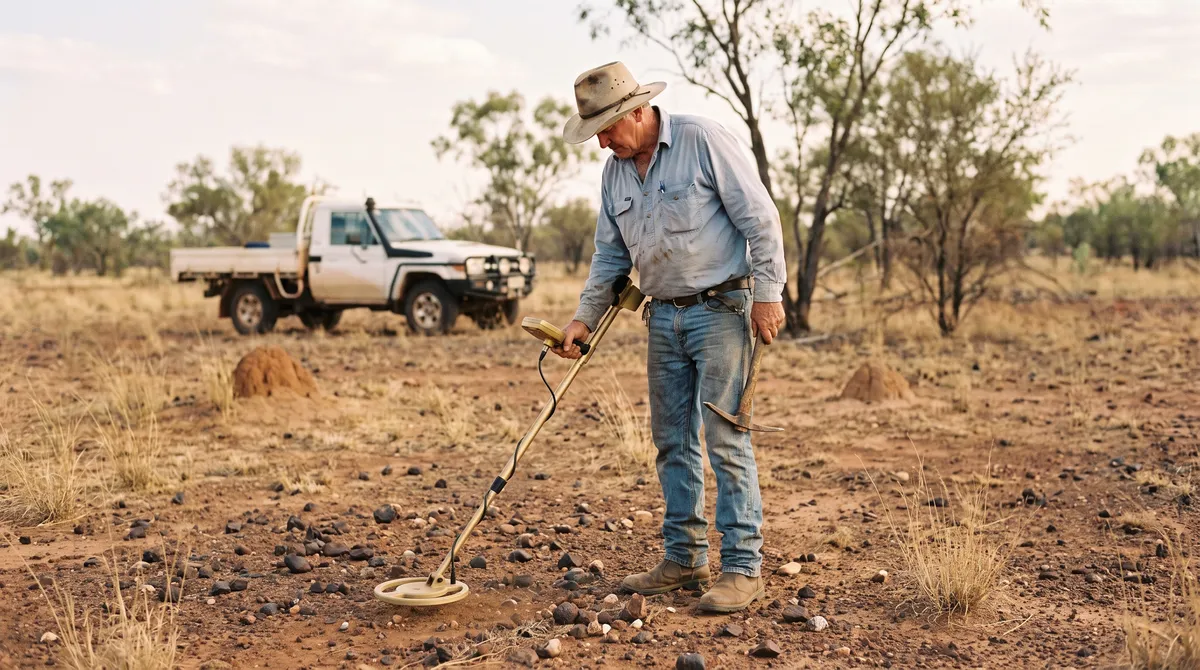
Queensland has the simplest detecting system in Australia, and it is simple because it is strict. There is one licence, it is required everywhere, and the state runs a network of designated ground where that licence is all the permission you need.
Two words in that description do most of the work. Everywhere means the licence applies on a mate’s cattle property just as much as on public land. And off the designated ground, the landholder’s permission has to be written. A handshake at the homestead gate does not meet the requirement.
This is general orientation rather than legal advice. Rules change, areas open and close, and the conditions on any particular block can change the answer — check with the Queensland Government and the landholder before you dig.
For the national picture, start with our guide to metal detecting rules across Australia. The neighbouring states work very differently, as our guides to NSW and Victoria show.
The fossicking licence
Fossicking in Queensland is governed by the Fossicking Act 1994. To fossick is to search for or collect fossicking materials from the surface or by digging with hand tools. Fossicking materials are gemstones, ornamental stones, mineral specimens, alluvial gold including nuggets, and some fossils — but not meteorites or the fossils of vertebrate animals.
A fossicking licence is required to do that anywhere in the state. There are five types: individual, family, club, educational organisation and commercial tour operator. A family licence covers the holder plus their spouse and any children or students under 23 living with them, and the three group licences cover up to 50 people at one time and place. Individual and family licences come in one-month, six-month and one-year terms, bought online from the Queensland Government. Carry it whenever you fossick. Showing it on your phone is accepted.
A Miner’s Right or permit from another state does nothing here.
What the licence allows:
- Hand tools only. Picks, shovels, hammers, sieves, shakers, hand sluices and metal detectors. No machinery.
- Limited depth. No deeper than 2 metres below the natural ground surface on land, or 0.5 metres in a stream.
- Occasional sales. Selling the odd lucky find is fine. Repeatedly removing material for sale, or fossicking to make a living, is commercial activity and needs mining tenure instead.
As in the other states, a council beach search for lost jewellery is not fossicking. Coins and rings are not fossicking materials, so the licence neither covers that nor is required for it. The council’s local laws are what apply.
Where the licence lets you go
Queensland land falls into four groups that matter to a fossicker.
Fossicking areas and designated fossicking land. These are established by the government with councils and landholders, signposted and published. Your licence is the only permission you need, subject to each area’s conditions.
General permission areas (GPAs). These are parts of properties where the landholder has given general permission for fossicking, camping or both. Again, the licence plus the published conditions of access is enough. If you stay overnight in a fossicking area, you may also need a fossicking camping permit.
State forests and timber reserves. Fossicking is allowed only where there is a GPA.
Everything else. You need the landholder’s written consent, so keep it with your licence. On land under a mining claim, mining lease or mining lease application you need the written permission of the holder or applicant, and that applies inside GPAs too.
Closed outright: national parks, conservation parks and wildlife reserves. Resources reserves are managed by the Queensland Parks and Wildlife Service, and the most famous of them is closed to detecting (more on the Palmer below).
The responsibilities are the ones you would expect, stated plainly. Refill every hole, take your rubbish out, do not damage trees or clear vegetation, do not pollute water, do not interfere with stock or wildlife, and do not interfere with any heritage or cultural site. In a watercourse, do not dig within 40 metres of a bridge, weir or other structure. On designated fossicking land, stay on made tracks and light fires only in designated places or on cleared ground. Breaches can mean an infringement notice, prosecution or cancellation of the licence.
Gold country
Clermont is the obvious place to start. The Central gold district has twelve general permission areas around the town, most of them north-west along Laglan Road and one to the south off McDonald Flat Road, with names like Flat Diggings, Four Mile, McMasters and Town Reserve. The gold that matters to detectorists is in the young alluvial and eluvial ground, and the state’s own notes record that nuggets over 15 grams were once common. Mining claims and leases sit among the GPAs, so read the maps and the conditions of access before you swing a coil.
Warwick has two gold fossicking areas, Thanes Creek and Deep Creek, and the state also lists gold fossicking near Gympie, where James Nash’s 1867 find started the rush often credited with rescuing Queensland’s finances.
Mount Morgan has a general permission area around the No 7 Dam reserve, below a mine that produced about 250 tonnes of gold between 1882 and 1981. Hand tools including detectors are allowed, holes are limited to 2 metres by 1 metre and half a metre deep, there is no camping, and children must be supervised.
The Palmer River is off-limits. The Palmer Goldfield Resources Reserve protects the remains of the 1870s rush, and Queensland Parks and Wildlife Service does not permit the public to use prospecting, panning or metal detecting equipment there. Fines apply. It is the best-known name in Queensland gold and the one place in this list you cannot hunt.
A famous name does not mean open ground anywhere else either. Old fields are often built over, heritage-protected or held under modern mining tenure. The designated areas exist precisely so you do not have to untangle that alone.
Queensland is gem country too: sapphires on the Central Queensland gemfields around Anakie, Rubyvale and Sapphire, topaz near Stanthorpe, agate, topaz and moonstone in the north, and opal in the west. The same licence covers all of it, though a detector will not help you find a sapphire.
Clermont’s small gold reads low on a detector, as small gold does everywhere, and ironstone ground makes it harder to hear. Our Australian goldfields field guide covers technique in mineralised ground, and our guides to detector settings and VDI numbers go further into the technical side.
Heritage law still applies
Aboriginal and Torres Strait Islander cultural heritage. The Aboriginal Cultural Heritage Act 2003 and the Torres Strait Islander Cultural Heritage Act 2003 impose a cultural heritage duty of care. Anyone carrying out an activity must take all reasonable and practicable measures to avoid harming cultural heritage. If you encounter what may be an artefact, stop, disturb nothing further, record the location and report it.
Historical artefacts. The Queensland Heritage Act 1992 covers historical archaeology and requires the discovery of important archaeological artefacts to be reported to the state. Old goldfield camps, hut sites and the remains of Chinese settlements on the northern fields are exactly the places where that applies. If you dig something that looks historically important, report it rather than pocketing it.
Beaches, parks and council land
Queensland’s coastline — the Gold and Sunshine Coasts, the Capricorn Coast, Townsville, Cairns — is where most day-to-day detecting happens, and it is council territory. Local laws differ from council to council, and some restrict detecting to particular beaches or conditions. Ask the specific council and keep the answer.
Two Queensland-specific cautions. Marine park zoning covers long stretches of the coast and can restrict collecting. And from around Gladstone north, estuaries and beaches are crocodile country. Take the warning signs seriously and keep well back from the water’s edge, especially around creek mouths.
Our check-before-you-dig checklist sets out the general framework, and beach detecting covers salt, tides and wet-sand settings.
Private land, in writing
Queensland’s grazing country sees little detecting pressure, and old station camps, stock routes and coach-stop sites are worth asking about. The permission must be written, and a copy kept with your licence is the simplest way to show you have it.
The conversation is the usual one. Our guide to asking for permission covers it and suggests a simple agreement to write down, which in Queensland also serves as your legal consent. Ask about stock, gates, bores and troughs, and in the north, which tracks close in the wet.
Safety
Heat. Central Queensland summers are hot enough that most serious detectorists work the cooler months. Carry more water than seems sensible.
The wet. Summer rain cuts roads and turns black soil impassable, particularly in the north. Check road conditions before and during a trip.
Old workings. The historic fields have old shafts and diggings. Watch your feet and never stand on a covered shaft.
Snakes and coverage. Boots, gaiters, a pressure bandage, a PLB, and someone who knows your plan.
Keep the paperwork with the finds
Queensland generates the most paperwork of the eastern states, and much of it expires. A one-month licence runs out quickly, GPAs carry their own conditions of access and sometimes their own end dates, and every private-land consent has to be in writing.
Photograph the licence and each written consent and keep them on your phone. Then log each hunt with a note of which area or property it was and what permission you were there under. DetectingLog keeps a GPS pin and notes with every hunt, so a logbook kept that way answers an inspector’s question on the spot and tells you next season which GPA actually gave up gold.
Keep those results to yourself, too. A productive corner of a GPA stays productive only as long as it stays quiet, which is the argument for keeping detecting locations private.
Queensland is the easiest state to get right. Buy the licence, start on designated ground, get everything else in writing, and leave the Palmer to the historians.
Frequently asked questions
Do I need a licence to metal detect in Queensland?
To look for gold or gemstones, yes. Queensland requires a fossicking licence to fossick anywhere in the state, including on designated fossicking land and on private property. Searching a council beach for lost coins and jewellery is not fossicking under the Fossicking Act 1994, so the licence does not apply there, but the council's local laws do.
Where can I metal detect for gold in Queensland?
Start with the state's fossicking areas and general permission areas, where the licence is all the permission you need. The twelve general permission areas around Clermont are the best known for gold, and there are gold fossicking areas near Warwick and a general permission area at Mount Morgan. Anywhere else you need the landholder's written consent. National parks, conservation parks and wildlife reserves are closed to fossicking.
Can I metal detect on the Palmer River?
Not in the Palmer Goldfield Resources Reserve. Queensland Parks and Wildlife Service does not permit the public to use prospecting, panning or metal detecting equipment there, and fines apply. The reserve protects the remains of the 1870s gold rush.
Keep reading
Miner's Right Victoria: Cost, How to Get One and the Rules
A Victorian Miner's Right costs $29.40 for 10 years, rising to $41.40 on 1 January 2027. How to buy one, what it lets you do, and the rules attached.
Metal Detecting in the Northern Territory: Permit and Land Access
The NT has required a fossicking permit since June 2026. How the free permit, fossicking notices, pastoral land, Aboriginal land and gold limits work.
Metal Detecting in South Australia: No Permit, Always Permission
South Australia needs no fossicking permit, but every block needs someone's consent. How Crown land, parks, Jupiter Creek and Mount Crawford work.