
Metal Detecting in Australia: Permits, Parks, and State Rules
Detecting rules in Australia are set state by state. Here is how Miner's Rights, fossicking licences, heritage law, and park bans fit together.
Updated
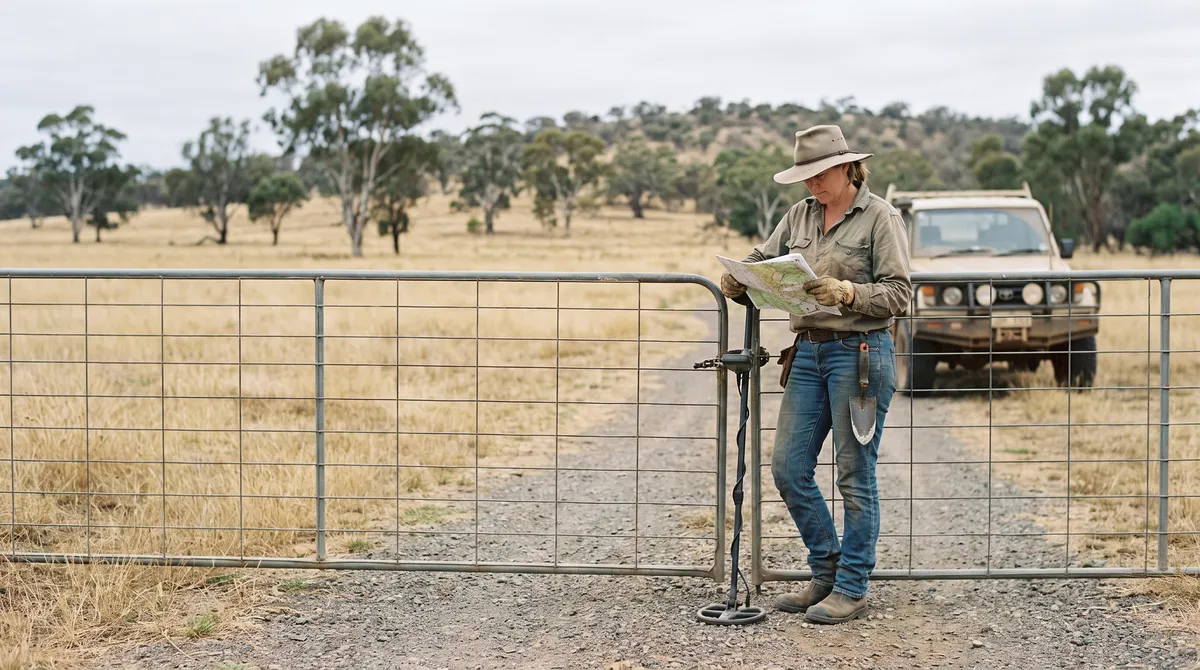
Australia has world-class detecting ground and no single national rulebook. Detecting law here is set state by state, layered over federal heritage and native title protections, and the answer to “can I detect here?” genuinely changes when you cross a border.
That sounds worse than it is. In practice you are answering four questions about any given piece of ground, and once you know the pattern you can work it out quickly.
This is general orientation rather than legal advice. Rules change, and the specifics of any particular site can shift the answer — always check with the authority that manages the land.
The four questions
For any spot you are considering:
- Who owns or manages this land? Private, Crown, council, national park, reserve, or Aboriginal land.
- Do I have permission from them? Written, if at all possible.
- Do I need a permit or licence for what I am doing? Prospecting for gold and minerals is regulated separately from searching for coins and relics.
- Is this place protected? Heritage listings, Aboriginal cultural heritage, national parks, and marine parks all override everything above.
Get those four right and you are almost certainly fine. Skip question four and you can be in serious trouble on ground that looked completely ordinary.
Prospecting versus detecting
This distinction runs through all the state legislation and it confuses a lot of newcomers.
Prospecting or fossicking means searching for gold, minerals, and gemstones. It is regulated under mining legislation, and it typically requires a Miner’s Right or fossicking licence on Crown land. These are inexpensive, generally available online, and usually valid for a set term.
Detecting for coins, relics, and jewellery in parks and on beaches is a different activity, and it is generally governed by whoever manages the land plus heritage law — not by mining legislation.
Plenty of detectorists do both, sometimes in the same outing, and the same machine covers both. But the permissions are separate, and holding a Miner’s Right does not authorise you to detect in a council park or dig historic relics.
If gold is what you are after, the technique, the machines and the ground are all different from park and beach detecting — our Australian goldfields field guide covers where the country is, why a general-purpose detector struggles in mineralised soil, and how to read old workings.
Critically, a Miner’s Right does not override any other law. It permits prospecting; it does not exempt you from heritage legislation, park rules, or trespass.
State by state
Each jurisdiction runs its own scheme, and authorisations are not transferable between states. A Victorian Miner’s Right does nothing for you in Queensland.
Victoria issues a Miner’s Right under the Mineral Resources (Sustainable Development) Act 1990, which covers prospecting for gold, gemstones, and minerals on Crown land where prospecting is permitted. Victoria is the historic goldfields state and there is a great deal of legal ground, but the Heritage Act sits alongside the Miner’s Right and protects historic mining sites and relics — which are exactly the places that look most appealing. Historic mining infrastructure is common in Victorian bush and disturbing it is an offence. Our Victorian guide goes a level deeper on the state — where the Miner’s Right applies, the handful of park exceptions, and how to read the Golden Triangle — and our Miner’s Right guide covers the permit itself.
New South Wales does not require a licence for recreational fossicking on land where fossicking is permitted, though a permit is required for State forests. Crown land and private land both need the relevant permission. The Heritage Act protects relics. Our NSW guide covers the consents, the take limits and the relics law in detail.
Queensland requires a Fossicking Licence, and rights issued in other states are explicitly not recognised. Queensland has designated fossicking areas which are the simplest legal starting point. Our Queensland guide covers the licence, the fossicking areas and the Clermont goldfield.
Western Australia treats the use of a metal detector to search for minerals as prospecting. A Miner’s Right is required, and prospecting on larger areas or on someone else’s tenement brings further requirements. WA has vast prospecting ground and an equally vast amount of it sits inside active mining tenements, where you need the tenement holder’s permission. Our Western Australian guide covers tenements, 40E permits and prospecting on pastoral stations.
South Australia requires no fossicking permit, but very little is open by default. You need the landowner’s permission, the environment department’s consent on Crown land, and a ForestrySA permit for the designated fossicking areas at Mount Crawford, and what you find may not be sold. Our South Australian guide covers the consents, the public goldfield sites near Adelaide and the relics law.
Tasmania requires a Prospecting Licence to use a metal detector for minerals, bans detectors from its licence-free fossicking areas, and makes it an offence to carry one onto reserved land without an authority. Our Tasmanian guide covers the licence, the access map and the reserve rules.
The Northern Territory has required a fossicking permit since June 2026. The permit is free, but most land also needs a written notice to the landholder, or their consent, before you enter. Our Northern Territory guide covers the permit, the notice system and the gold limits.
The ACT is largely reserve and protected land, so assume restrictions.
Fees and terms change, so treat any figure you read online — including on detecting forums — as indicative only, and buy the permit through the official state department rather than a third party.
Where you almost certainly cannot detect
National parks and conservation reserves. Metal detecting and ground disturbance are prohibited in national parks across effectively every Australian jurisdiction. This is the single most common way recreational detectorists get into trouble, because park boundaries in bushland are not always obvious on the ground. Check the map before you go, not after.
Aboriginal cultural heritage sites. Aboriginal objects and places are protected by both state and Commonwealth legislation, and protection applies whether or not a site is registered or marked. Disturbing Aboriginal cultural heritage carries severe penalties, and the fact that you did not know is not a defence. If you encounter artefacts, stop, do not disturb anything further, and report it to the relevant state authority.
Heritage-listed places. State heritage registers cover historic mining sites, shipwrecks, buildings, goldfields infrastructure, and archaeological sites. These are frequently the most tempting-looking ground available, which is exactly why the protections exist.
Marine parks and protected foreshores. Coastal rules vary considerably and can differ between the dry sand, wet sand, and dunes on a single beach. Dune systems are often protected for erosion control independently of any heritage consideration.
Historic shipwrecks, protected under Commonwealth legislation, along with their associated relics in the intertidal zone.
Beaches, parks, and council land
For most Australian detectorists, day-to-day detecting means beaches and local parks — and those are governed by whichever council or land management authority controls them.
There is no general rule. Some councils permit detecting freely, some require a permit, some restrict it to certain areas or hours, and some prohibit it outright. Neighbouring councils frequently take opposite positions.
The only reliable approach is to ask the specific council. A short phone call or email to the parks or open space team gets you a definitive answer, and if it is a yes, you have something to point to if someone questions you on site. Our legal checklist sets out a general check-before-you-dig framework that works anywhere.
Beaches bring their own technical challenges on top of the legal ones — salt, tides, and settings that behave nothing like inland ground. Our guide to beach detecting covers that side.
Private land
Private property is the most straightforward category legally and the most valuable practically, because it sees virtually no detecting pressure.
You need the landowner’s permission, and that is essentially it — heritage protections still apply, but the permit questions largely fall away. Rural Australia has enormous quantities of ground that has never been detected, and farm permissions are the backbone of serious detecting almost everywhere.
The approach is the same as anywhere: be direct, be respectful, explain what you do, promise to fill every hole and take out any trash you find, and offer to show them anything you dig. Our guide to asking for permission walks through the conversation and the simple written agreement worth having afterwards.
Australian-specific etiquette worth knowing: ask about livestock and shut every gate behind you, ask about crop stages before walking a paddock, and take fire restrictions seriously — during total fire bans, vehicle access to grassland can be restricted or prohibited outright.
Safety in the Australian bush
The legal risks are manageable. The environmental ones deserve genuine respect, particularly on goldfields ground far from anywhere.
Heat and water. Carry far more water than you expect to drink. Detecting is steady physical work, often in open sun, and heat exhaustion arrives faster than people expect.
Communications. Much of the good prospecting country has no mobile coverage. A PLB or satellite communicator is standard equipment for anyone going out alone, and someone should always know your intended location and return time.
Old mine workings. Historic goldfields are full of unmarked shafts, some of them deep, many concealed by vegetation. This is a real and recurring cause of serious accidents. Watch your feet, and never assume a covered shaft is safe to stand on.
Snakes. Boots, gaiters, awareness, and a pressure bandage in the pack.
Vehicle preparation. Recovery gear, spare fuel, and a realistic assessment of the track before you commit to it.
Log the permissions, not just the finds
Australian detecting generates a lot of administrative detail worth keeping straight: which council said yes to which beach, when your Miner’s Right expires, which paddock the farmer asked you to avoid during lambing, and which state you were in when you dug what.
That is exactly the kind of thing that lives well alongside your hunt records. Keeping the permission details, the licence expiry, and the site notes together with your logbook means you can answer a question about access on the spot instead of trying to remember an email from eight months ago. Drop a GPS pin on the boundaries the landowner asked you to respect, and the ambiguity disappears entirely.
It is also worth keeping your site locations to yourself. Australian permissions are hard-won and easily lost, and a productive paddock that gets shared around stops being productive quickly — the reasoning behind keeping detecting locations private.
Detecting in Australia rewards preparation more than most places. The ground is good, the access is genuinely available if you ask properly, and the main thing standing between you and a great season is knowing which four questions to answer before you leave the house.
Frequently asked questions
Do you need a permit to metal detect in Australia?
It depends on the state and on what you are searching for. Prospecting for gold and minerals on Crown land generally requires a Miner's Right or fossicking licence, issued by each state separately and not transferable between them. Detecting on private land needs the owner's permission but usually no permit.
Can I metal detect in Australian national parks?
Almost never. National parks, conservation reserves, and most protected areas prohibit metal detecting and ground disturbance across every state and territory. Assume it is banned unless the managing authority explicitly says otherwise in writing.
Is a Victorian Miner's Right valid in other states?
No. Each state and territory runs its own scheme under its own legislation. A Victorian Miner's Right has no effect in Queensland, New South Wales, or Western Australia — you need the relevant authorisation for the jurisdiction you are actually detecting in.
Keep reading
Miner's Right Victoria: Cost, How to Get One and the Rules
A Victorian Miner's Right costs $29.40 for 10 years, rising to $41.40 on 1 January 2027. How to buy one, what it lets you do, and the rules attached.
Metal Detecting in the Northern Territory: Permit and Land Access
The NT has required a fossicking permit since June 2026. How the free permit, fossicking notices, pastoral land, Aboriginal land and gold limits work.
Metal Detecting in South Australia: No Permit, Always Permission
South Australia needs no fossicking permit, but every block needs someone's consent. How Crown land, parks, Jupiter Creek and Mount Crawford work.