Metal Detecting in South Australia: No Permit, Always Permission
South Australia needs no fossicking permit, but every block needs someone's consent. How Crown land, parks, Jupiter Creek and Mount Crawford work.
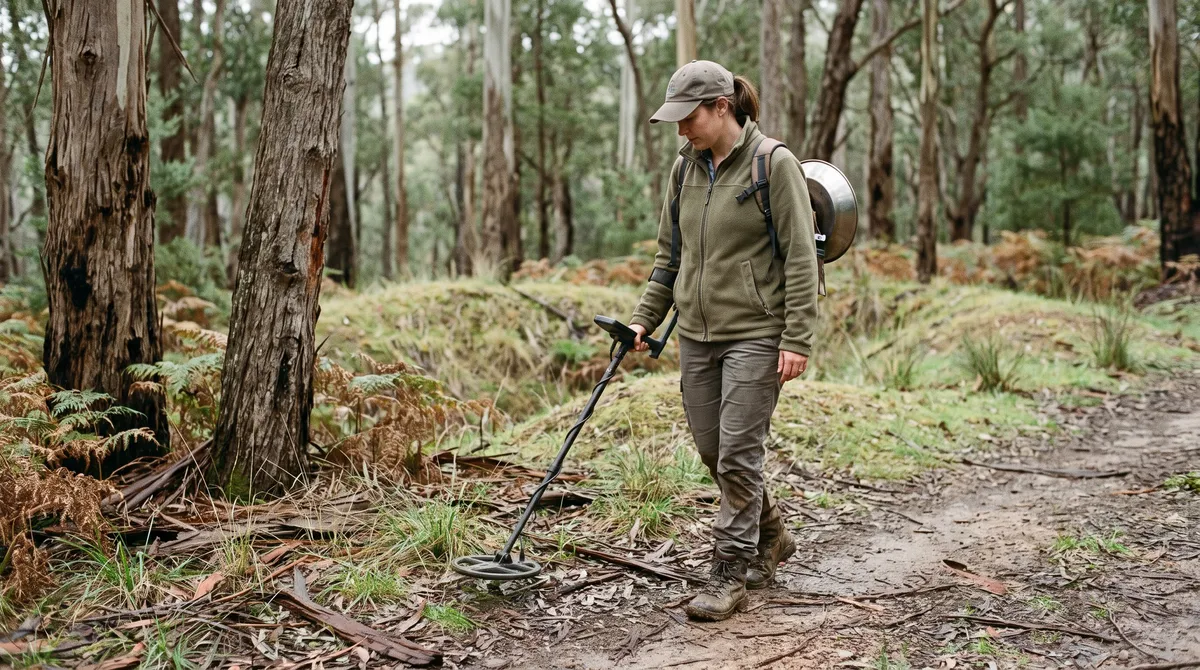
South Australia asks for no fossicking licence, no Miner’s Right and no fee to the mining department. That makes it sound like the easiest state in the country, and it is not.
What the state asks for instead is permission, every time, from whoever holds the ground. That includes the Crown. Apart from a couple of designated sites in the Adelaide Hills, very little public land here is open by default, and “it’s Crown land, so it’s fine” is the assumption that gets people into trouble.
This is general orientation rather than legal advice. Rules change, sites open and close, and the details of any particular block can change the answer — check with the department and the land holder before you dig.
For the national picture, start with our guide to metal detecting rules across Australia. The neighbouring states work very differently, as our guides to Victoria, NSW and Western Australia show.
No permit, and nothing to sell
South Australia’s Mining Act 1971 defines fossicking as gathering minerals as a recreation, with no intention to sell them or use them for a commercial or industrial purpose, and without disturbing land or water with machinery or explosives. The Department for Energy and Mining lists the accepted tools as hand-operated equipment: picks, shovels, gold pans and metal detectors.
Three things follow from that definition.
- No fossicking permit. The Act does not require one.
- No sales. What you find can go into your own collection, and the department says plainly that minerals collected by fossicking are not to be sold. That is stricter than Queensland, where selling the occasional lucky find is allowed.
- No machinery. Power-operated equipment is classed as mining, and it belongs on a registered mineral claim or mining lease.
All minerals in the ground are the property of the Crown.
Hunting lost coins and rings is a different activity. It is not gathering minerals, so the fossicking rules are not what govern it. The land manager’s rules are, and on Crown land the ban on digging without authority applies whatever you are looking for.
Permission is the whole system
With no licence to buy, everything turns on whose ground it is.
Private land. You need the landowner’s authorisation before you enter, and the owner can add limits of their own on top of the Act’s.
Crown land. This is the one that catches people out. Excavating, damaging or interfering with Crown land without lawful authority is an offence under the Crown Land Management Act 2009, so fossicking on unalienated Crown land needs the consent of the Department for Environment and Water. Ask before you go. Where fossicking on Crown land is permitted, the department’s guide confirms that metal detectors can be used.
Mining tenements. You cannot enter ground held under a mineral claim, mining lease, retention lease, miscellaneous purposes licence or private mine to fossick without the holder’s prior approval. An exploration licence is different: the department says you do not need the licence holder’s permission if all you are doing is fossicking. You still need the landowner’s. SARIG, the state’s online resources map, shows every current tenement.
Pastoral leases. The north of the state is station country. Public Access Routes let you drive across a lease without asking, but leaving a route, or camping off one, needs the lessee’s consent. Treat fossicking the same way and ask the lessee first.
Where the public can actually go
Two places in the Adelaide Hills are set up for fossickers. Both began as gold rushes.
Jupiter Creek Diggings, near Echunga. William Chapman found gold near Echunga in 1852, and the Old Echunga Diggings produced about 3,100 kilograms, most of it by 1855. Jupiter Creek followed, with about 930 kilograms won mainly between 1868 and 1871. Today the Jupiter Creek Diggings are a historic reserve managed by the Department for Energy and Mining, and fossicking is permitted. The conditions are short:
- non-mechanical tools only, such as pans, hand sluices and metal detectors;
- keep holes to a minimum and backfill them immediately;
- stay out of the restricted access areas and away from the old mineshafts;
- do not disturb any historic place, object, relic or archaeological site;
- no camping, no fires, and no entry at all on total fire ban days.
The reserve is heritage listed under the Heritage Places Act 1993, and the department is explicit that archaeological artefacts may not be removed. You are there to fossick, not to collect what the old miners left behind. There are no facilities.
Chapel Hill Diggings are closed. The other reserve on the Echunga field has been declared unsafe for public access by SafeWork SA. It has large numbers of deep, unfenced shafts hidden in dense vegetation, and asbestos, and the department has fenced it. Stay out.
Mount Crawford Forest. John Watts made a rich strike in 1884 in the gully now named after him, and a rush followed in 1885. ForestrySA allows fossicking in designated areas of the Mount Crawford Forest Reserve, including the Watts Gully Diggings, with a ForestrySA fossicking permit. It comes as a daily or annual permit and has to be bought online before you start. Only hand-operated tools such as pans and metal detectors are allowed, holes must be kept small and backfilled immediately, streams must not be dammed or diverted, and active harvesting sites are off limits. The forest closes on total fire ban days.
ForestrySA says outright that detectors have brought more fossickers into the forest and that the effect on its soils is a concern. A tidy site is how this access stays open.
Where you cannot go
National parks, conservation parks and reservoir reserves. All closed to fossicking. The Department for Environment and Water states that under the National Parks and Wildlife Act 1972 it is an offence to use a metal detector, dig or disturb soil within a reserve. Forest reserves are closed too, outside the designated Mount Crawford areas.
The Barossa Goldfields. Discovered in 1868 and worked into the 1930s for an estimated 3,110 kilograms of gold, the field now lies inside Para Wirra Conservation Park. Walk the interpretive trails, visit the Bowden Cottage museum, keep to the tracks because of the mine shafts, and leave the detector at home.
The northern fields
South Australia’s most productive goldfield was not in the Hills. Teetulpa, in the pastoral country of the north-east, produced about 3,132 kilograms of alluvial gold, mainly between 1886 and 1889, and the department notes that sporadic alluvial mining and fossicking continue there to the present. Waukaringa, Wadnaminga, Mannahill and Ulooloo are other old fields in the same part of the state.
None of that makes them open ground. This is station country overlaid with old and current mining tenure, so the permission question has more layers than it does in the Hills. Start with SARIG, find out who holds the block, and get their consent before you drive in.
One technical note from the department is worth repeating. Metal detectors respond to nuggets, coins and ironstone, but they are not generally useful for fine alluvial gold or reef gold. On a field that produced fine gold, a pan earns its place beside the detector. Our Australian goldfields field guide covers technique in mineralised ground, and our guide to VDI numbers explains why small gold reads the way it does.
Heritage law
Aboriginal heritage. Under the Aboriginal Heritage Act 1988 it is an offence to damage, disturb or interfere with any Aboriginal site, object or remains without the Minister’s authorisation. If you come across what may be an artefact or remains, stop, leave everything in place, note the location and report it.
Historical relics. This is where South Australia is stricter than many detectorists expect. The Heritage Places Act 1993 does not only protect listed places. It also prevents anyone from actively searching for significant buried archaeological artefacts without a permit from the South Australian Heritage Council, and from disturbing land that is likely to hold them. “Archaeological artefacts” here means the remains of non-Aboriginal settlement and exploration: homestead ruins, shepherds’ huts, wells, cesspits, mine workings and the household goods around them.
So the landowner’s permission does not, on its own, clear you to dig an old ruin for relics. If you uncover buried artefacts by accident, Heritage South Australia asks that you notify it before excavating any further.
Beaches and shipwrecks
Most day-to-day detecting in South Australia happens on beaches and in local parks, and those are council territory. Councils can make their own by-laws, and neighbouring councils do not always agree. Ask the specific council and keep the answer. Our check-before-you-dig checklist sets out the general framework, and beach detecting covers salt and wet sand.
Shipwrecks have their own law. The Historic Shipwrecks Act 1981 protects wrecks in state waters, which takes in Gulf St Vincent, Spencer Gulf, the proclaimed historic bays, inland rivers and lakes, and everything above the high tide mark. The Commonwealth Underwater Cultural Heritage Act 2018 covers the waters beyond. Every shipwreck and shipwreck relic 75 years old or more is protected automatically, and the department’s instruction is blunt: you must not move or collect any article that may be a historic relic.
A relic can be a timber, a bolt, a fitting, a piece of cargo or somebody’s personal belongings. If you find one on a beach or a riverbank, leave it, record where it is, and notify the Department for Environment and Water. Because inland rivers are included, that applies on the Murray as much as on the coast.
Private land
Farm permissions are where South Australia opens up, because so little else is available. The conversation is the usual one, and our guide to asking for permission walks through it and the short written agreement worth having afterwards. Ask about stock, gates, crops and fire restrictions, and remember that the heritage rules above still apply on private ground.
Safety
Shafts. The Hills diggings are full of old workings, many unfenced and hidden by scrub. That is the reason Chapel Hill is shut. Watch your feet and never step backwards while swinging.
Fire. Total fire ban days close Jupiter Creek and the ForestrySA forests, and fires are prohibited on ForestrySA land from 1 November to 30 April. Check the fire danger rating before you leave home.
Heat and distance. The northern fields are remote and dry. Carry far more water than you plan to drink, tell someone your route and return time, and take a PLB or satellite messenger.
Snakes. Boots, gaiters and a pressure bandage in the pack.
Keep the consents with the finds
South Australia gives you no licence to show anyone. What you have instead is a set of consents: the farmer’s, the department’s for a Crown block, a ForestrySA permit with a date on it, a tenement holder’s approval. If someone asks why you are there, those are your answer.
Photograph each one and keep it on your phone, then log every hunt with a note of whose consent you were there under. A logbook covers it. DetectingLog keeps a GPS pin and notes with every hunt, so the pin shows where you were and the note records the permission you were there under.
Keep productive ground to yourself as well. Access here depends on goodwill, and a paddock that gets talked about is a paddock that gets closed, which is the argument for keeping detecting locations private.
South Australia does not charge you for a licence. It expects you to have asked.
Frequently asked questions
Do I need a permit to metal detect in South Australia?
Not a fossicking permit. The Mining Act 1971 does not require one, and a metal detector is an accepted fossicking tool. What you do need is permission to be on the land: the landowner's on private property, the Department for Environment and Water's on Crown land, and a ForestrySA fossicking permit for the designated areas of Mount Crawford Forest. National parks and conservation parks are closed to detecting altogether.
Where can I metal detect for gold near Adelaide?
There are two public sites. Fossicking is permitted at the Jupiter Creek Diggings near Echunga, a heritage-listed reserve managed by the Department for Energy and Mining, and in the designated fossicking areas of Mount Crawford Forest, including the Watts Gully Diggings, with a ForestrySA permit bought online beforehand. The Chapel Hill Diggings are closed to the public for safety reasons, and the Barossa Goldfields are inside Para Wirra Conservation Park, where detecting is not allowed.
Can I sell gold I find fossicking in South Australia?
No. South Australia defines fossicking as gathering minerals for recreation with no intention to sell them or use them commercially, and the Department for Energy and Mining states that minerals collected by fossicking are not to be sold. You may keep them for your own collection.
Keep reading
Miner's Right Victoria: Cost, How to Get One and the Rules
A Victorian Miner's Right costs $29.40 for 10 years, rising to $41.40 on 1 January 2027. How to buy one, what it lets you do, and the rules attached.
Metal Detecting in the Northern Territory: Permit and Land Access
The NT has required a fossicking permit since June 2026. How the free permit, fossicking notices, pastoral land, Aboriginal land and gold limits work.
Metal Detecting in Tasmania: Prospecting Licence and Reserves
In Tasmania a detector needs a prospecting licence, is banned from fossicking areas and cannot be carried onto reserved land. How the rules fit together.