
Metal Detecting in Tasmania: Prospecting Licence and Reserves
In Tasmania a detector needs a prospecting licence, is banned from fossicking areas and cannot be carried onto reserved land. How the rules fit together.
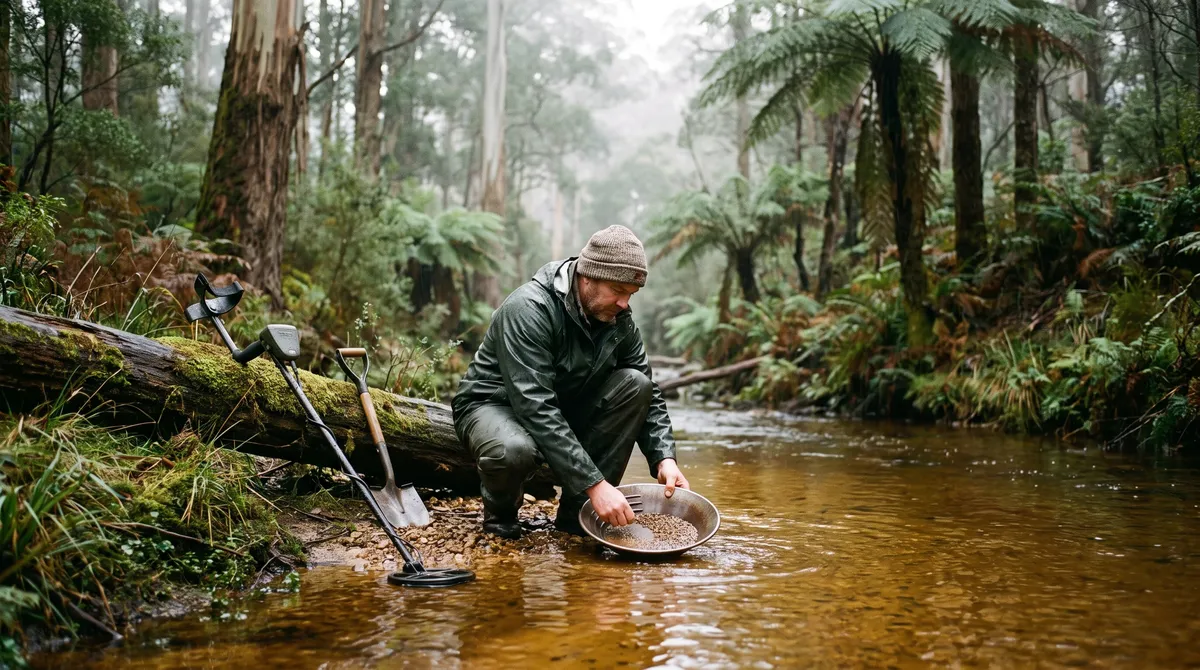
In most of Australia the law cares about what you are doing: prospecting, fossicking, digging. Tasmania also cares about what you are carrying. A metal detector is banned by name from the state’s licence-free fossicking areas, and on reserved land it is an offence simply to have one with you.
Between those two prohibitions there is a workable system. There is one licence, it lasts five years, and the state publishes a map that tells you, block by block, whether it applies.
This is general orientation rather than legal advice. Rules and land tenure change, and the details of any particular block can change the answer — check with Mineral Resources Tasmania and the land manager before you dig.
For the national picture, start with our guide to metal detecting rules across Australia. The mainland states each do it differently, as our guides to Victoria, South Australia and Queensland show.
Prospecting, fossicking, and where a detector fits
Mineral Resources Tasmania (MRT) administers two activities under the Mineral Resources Development Act 1995, and the difference between them decides everything for a detectorist.
Prospecting means exploring for minerals to a depth of less than 2 metres with a hand-held instrument, metal detectors included. It needs a Prospecting Licence.
Fossicking means searching for minerals for a purpose other than commercial gain, to a depth of 2 metres, by hand or with hand-held instruments. Inside one of the state’s eleven declared fossicking areas it needs no licence at all.
Then comes the catch. Metal detectors are not permitted in the fossicking areas. The licence-free option is closed to anyone swinging a coil, so in Tasmania a detectorist is always a prospector.
The Prospecting Licence
MRT issues the licence for five years at a prescribed fee. You can apply at a Service Tasmania shop or send MRT the application form. Check the current fee with MRT rather than trusting a figure from a forum.
The licence covers prospecting for recreational or educational purposes only, and it comes with a page of conditions. The ones that matter most in the field:
- Hand-held tools only. A metal detector may be used anywhere that prospecting is allowed.
- No dredges, suction dredges, trommels or motorised pumps. Hand-held, unpowered sluices and highbankers under a metre long are allowed.
- No explosives and no mercury.
- Leave the banks alone. No excavating a natural stream bank, no undermining, and no prospecting in roadside gutters or road embankments.
- Restore the ground. Diggings go back to normal surface level before you leave, and no vegetation is to be cut or removed.
- Stay on formed tracks with the vehicle.
- Keep out of karst. No digging in a sinkhole, or within 10 metres of a cave entrance.
Two conditions are unusual enough to remember. A person who finds a meteorite must deliver it to the Trustees of the Tasmanian Museum, and mineral or fossil specimens that are out of the ordinary should be referred to MRT.
Community groups, schools and businesses can apply for a Group Prospecting Licence, which lets up to 20 people prospect in pre-approved areas without holding licences of their own.
Where the licence works
The licence allows prospecting on some of the land the Act covers, not all of it. MRT’s answer to “which?” is the Prospecting Access Map Viewer. Search for a place, tap the exact spot you have in mind, and a pop-up shows the land tenure and whether prospecting is allowed, not allowed, or allowed only with permission. It also shows any mineral tenement over the ground. MRT’s advice is to read every record in that pop-up.
Two kinds of ground always need someone else’s say-so.
Private land. Ask the landowner.
Mineral tenements. A mining lease, exploration licence or retention licence, whether granted or still under application, needs the consent of the tenement holder. If the tenement is still an application, you need the Director of Mines’ permission as well. MRT publishes a template approval form for exactly this.
Reserved land: leave the detector behind
This is the rule that surprises visitors. Under the National Parks and Reserves Management Regulations 2019, a person must not bring a metal detector onto any reserved land, or have possession of one there.
The single exception written into the regulation is a detector inside a vehicle that is moving on a road that does not terminate on reserved land. On that wording, driving a highway that crosses a reserve with a detector in the boot is fine. Parking inside a reserve with one in the boot is not obviously covered, so do not rely on it.
The same regulations make it an offence on reserved land to remove, damage or disturb any brick, glass, coin, masonry, ceramics, Aboriginal relic, or any object of archaeological or historical interest. Coins are named.
Reserved land is much more than national parks. It includes other reserve classes such as conservation areas, regional reserves, nature recreation areas and game reserves. The managing authority can grant an authority for an activity, and in some reserve classes it can authorise one generally by sign or published notice. Unless you know that has been done, assume the answer is no.
How this meets a Prospecting Licence on any particular reserve is a question for the map viewer first and, if the pop-up leaves any doubt, for MRT or the Parks and Wildlife Service. Get the answer before the trip, not at the gate.
Beaches
The reserved-land rule reaches the coast. The Bay of Fires, for one, is a conservation area, and conservation areas are reserved land. A beach being public does not make it council land, so find out who manages a stretch of coast before you carry a detector onto it.
Where a beach or park is managed by a council, the council decides. Ask the specific council and keep the answer. Our check-before-you-dig checklist sets out the general framework, and beach detecting covers salt and wet sand.
The fossicking areas, for the record
The eleven declared areas are Coal Hill, Colebrook Hill, Gladstone Hill, Killiecrankie Bay, Lord Brassey Mine, Lune River, Magnet Mine, Penguin, Tunnel Marsh, Weld River and Weymouth. They are set aside for fossickers and for gem and mineral collectors, from the surface to a depth of two metres, and MRT asks visitors to take only a fair share and leave commercial collecting out of it.
They are worth a family day with a sieve and a hand lens. Leave the detector in the car, provided the car is not parked on reserved land.
Gold country
Tasmania’s first payable gold was alluvial, found at Mangana in 1852, and it drew about 200 fortune seekers almost at once. The north-east followed: Lefroy, Back Creek and Waterhouse in 1869, Lisle in 1878, Gladstone in 1880 and Mount Victoria in 1882. Lisle is the curious one. It is estimated to have produced about 10 tonnes of alluvial gold, and the hard-rock source has never been found.
The biggest discovery came in 1877, when William and David Dally found a rich reef on Cabbage Tree Hill at Beaconsfield. It became the Tasmania Gold Mine, the largest in the state. At Mathinna, the Golden Gate mine produced more than 7 tonnes between 1888 and 1932.
The west coast produced the nuggets. Alluvial gold was worked around Corinna from the late 1870s, and in 1883 a tributary of the Rocky River gave up the McGinty nuggets, the two largest ever found in Tasmania, at 243 and 143 ounces. Casts of them are held by the Queen Victoria Museum and Art Gallery and by MRT.
MRT’s own booklet on alluvial gold is candid about what a detectorist faces. Dense vegetation covers most of the gold-bearing country and limits the use of the detectors that have found most of the mainland’s recent nuggets. It also notes that detectors have found some sizable nuggets in cleared areas.
A famous name is not an open gate. The old fields now sit under forest, farms, reserves and mining tenements in every combination, so each one starts with the map viewer. Our Australian goldfields field guide covers technique in mineralised ground, and our guide to keeping a settings log helps when every patch of ground behaves differently.
Heritage law
Aboriginal heritage. Under the Aboriginal Heritage Act 1975 nobody may destroy, damage, deface, conceal or otherwise interfere with a relic, or remove one from the place where it was found, except under a permit. Digging on Crown land for the purpose of searching for relics is an offence of its own. A person who finds a relic must inform the Director or an authorised officer as soon as practicable. If you turn up what may be an artefact, stop, leave it where it is, note the location and report it.
Historic sites and relics. The Prospecting Licence conditions say it in one line: no Aboriginal artefacts or site, and no historic relics or site, are to be damaged or removed. Tasmania is thick with convict-era and mining-era remains, and places on the Tasmanian Heritage Register are protected under the Historic Cultural Heritage Act 1995.
Shipwrecks. The Parks and Wildlife Service counts about 1,000 vessels lost in Tasmanian waters. Wrecks and their relics are protected under the Commonwealth Underwater Cultural Heritage Act 2018 and Tasmania’s Historic Cultural Heritage Act 1995. Ship’s fittings or old coins on a beach near a known wreck are not finds to keep. Leave them, record the spot and tell the Parks and Wildlife Service, which manages the state’s historic shipwrecks.
Private land
With so much of the state in reserves, farm permissions matter more in Tasmania than almost anywhere. Old homestead paddocks and coach roads on private land are the obvious places to ask about. Our guide to asking for permission covers the conversation and the short written agreement worth having afterwards. The heritage rules above still apply on private ground.
Safety
Weather. Tasmanian conditions turn quickly, and the west coast gold country is wet for much of the year. Pack for rain and for a night out, even on a day trip.
Old workings. The historic fields have shafts, adits and water races hidden under scrub. Watch your feet and never stand on a covered shaft.
Getting lost. Thick bush hides landmarks within metres. Mark the vehicle on your GPS before you walk away from it.
Snakes and coverage. Boots, gaiters, a pressure bandage, a PLB, and someone who knows your plan.
Keep the paperwork with the finds
A Tasmanian prospector collects a particular set of records: a licence with an expiry date five years out, the map viewer result for each spot, a tenement holder’s signed approval, a landowner’s consent. Screenshot the map pop-up on the day you check it, because tenure and tenements change.
Then log each hunt with a note of what you were relying on. A logbook covers it. DetectingLog keeps a GPS pin and notes with every hunt, so the pin shows where you were and the note records the permission you were there under.
Keep productive spots to yourself, too. Good ground is scarce here, which is the argument for keeping detecting locations private.
In Tasmania, check the map before you pack the detector. Do it in that order.
Frequently asked questions
Do I need a licence to metal detect in Tasmania?
To look for gold or other minerals, yes. Using a metal detector to search for minerals is prospecting under the Mineral Resources Development Act 1995, and it needs a Prospecting Licence from Mineral Resources Tasmania. The licence is issued for five years and covers recreational and educational prospecting with hand-held tools, on land where prospecting is allowed. You still need the owner's permission on private land and the holder's consent on a mining tenement.
Can I use a metal detector in Tasmania's fossicking areas?
No. Tasmania has eleven declared fossicking areas where no licence is needed, but metal detectors are not permitted in any of them. The areas are set aside for gem and mineral collectors working by hand. A detectorist needs a Prospecting Licence and has to work outside the fossicking areas.
Can I take a metal detector into a Tasmanian national park or reserve?
Not without an authority. The National Parks and Reserves Management Regulations 2019 make it an offence to bring a metal detector onto reserved land or to have one in your possession there. The only built-in exception is a detector inside a vehicle moving on a road that does not end on reserved land. Reserved land includes national parks and other reserve classes such as conservation areas.
Keep reading
Miner's Right Victoria: Cost, How to Get One and the Rules
A Victorian Miner's Right costs $29.40 for 10 years, rising to $41.40 on 1 January 2027. How to buy one, what it lets you do, and the rules attached.
Metal Detecting in the Northern Territory: Permit and Land Access
The NT has required a fossicking permit since June 2026. How the free permit, fossicking notices, pastoral land, Aboriginal land and gold limits work.
Metal Detecting in South Australia: No Permit, Always Permission
South Australia needs no fossicking permit, but every block needs someone's consent. How Crown land, parks, Jupiter Creek and Mount Crawford work.