The Responsible Beginner's Guide to Metal Detecting
Everything a new detectorist needs: choosing gear, getting permission, a simple hunt workflow, and the habits that turn you into a better hunter fast.
Updated
Most people who quit metal detecting in the first month quit for the same reason: they did it the hard way. They bought the wrong gear, swung over empty ground, annoyed a landowner, or dug a mess and got discouraged. None of that needs to happen to you.
Here’s how to start the right way — and actually stick with it.
Get one detector and learn it
You don’t need the most expensive machine. You need one detector you understand completely. A cheap detector in skilled hands out-finds a pricey one you’ve never learned to read.
When you’re choosing your first machine, weight matters more than features. You’ll swing it for hours, so balance beats a spec sheet. Look for three things:
- Comfortable weight and balance — your arm will tell you within an hour.
- Discrimination — so you can ignore obvious junk like nails and foil.
- Ground balance — so mineralised soil doesn’t drown you in false signals.
Buy used if you can. The hobby’s full of people upgrading, and last year’s mid-range detector is a fantastic starter.
The gear that actually matters
Beyond the detector, two things make the biggest difference for beginners:
- A pinpointer. This handheld probe finds the exact spot of your target in the hole. Without one, you’ll spend ages sifting dirt. With one, recovery takes seconds. It is the highest-value accessory in the hobby, and our pinpointer guide explains why it changes your results more than a detector upgrade would.
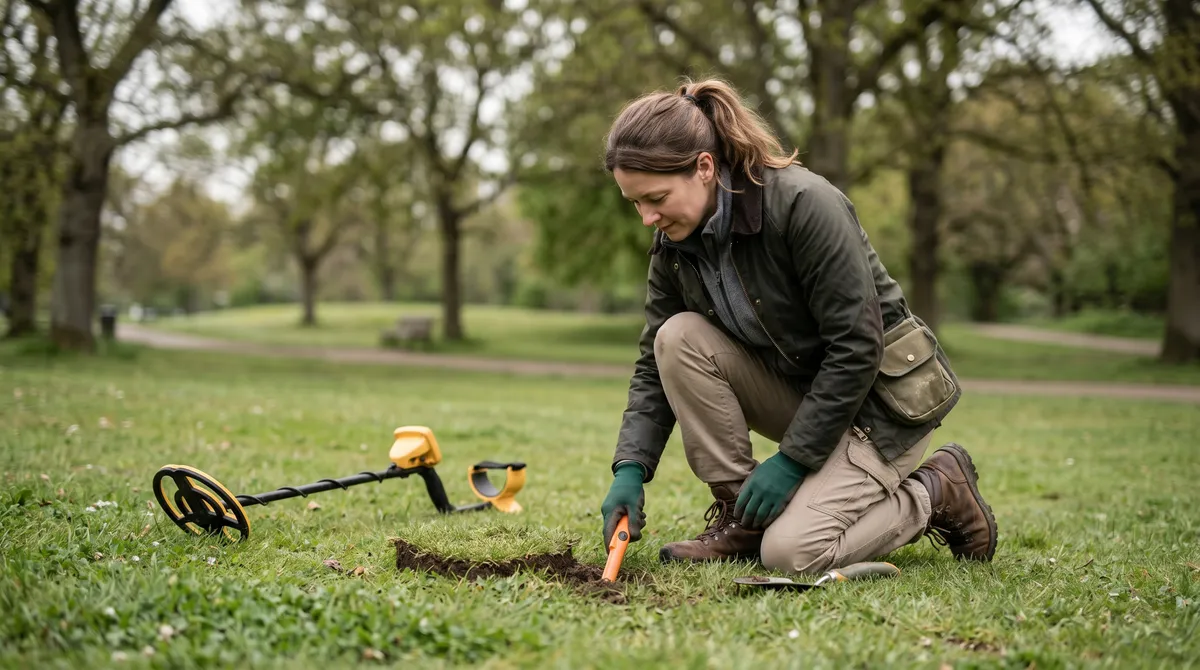
- A proper digging tool. A sturdy trowel or a purpose-made digger lets you cut a clean plug and put it back so the grass survives.
Add gloves, a finds pouch, and a small bag for trash. That’s it. Don’t over-buy.
Permission comes first. Always.
This is the part new detectorists skip, and it’s the part that matters most. Get permission before you detect anywhere that isn’t your own land.
Private property needs the owner’s say-so. Public land — parks, beaches, foreshores — usually has rules set by a council or land authority, and they vary wildly from place to place. Some spots are fine. Others are protected. A two-minute check saves you a very bad afternoon.
We’ve written two guides that cover this properly: start with where you can legally metal detect, then read how to ask a landowner for permission.
Your first hour: practise in the garden
Before you go anywhere, spend an hour on ground where nothing matters.
Bury a few known targets at known depths — a coin at 5 cm, another at 15 cm, a nail, a bottle cap — and sweep them. Listen to what each one sounds like. Watch what number appears. Then dig them up and put them back at different angles and see how the readings change.
This one hour teaches you more than your first three real hunts, because you know the right answer every time. It is also where you discover that your machine’s numbers are not the ones from the chart you read online, which is normal and covered in our VDI guide.
Practise cutting a plug here too. Doing it badly for the first time on someone’s lawn is a poor plan.
A simple first-hunt workflow
Keep it dead simple for your first few hunts:
- Pick easy ground. A grassy park or your own backyard. Avoid heavy trash and dense mineralisation while you’re learning.
- Swing low and slow. Keep the coil close to the ground and move it at a steady walking-pace sweep. Overlap each swing.
- Dig the clear signals. Solid, repeatable tones from multiple directions are worth digging. Broken, jumpy signals usually mean junk or iron.
- Cut a neat plug. Hinge it back like a flap so you can replace it.
- Pinpoint, recover, check. Use your pinpointer, pull the target, and scan the hole again in case there’s more.
- Refill completely. Every hole, even the empty ones.
How to dig a plug properly
This is the skill that most determines whether you are welcome back, and almost nobody explains it.
Cut three sides, not four. A U-shape or three-sided cut about 15 cm across, angled slightly inwards, leaves a hinge of intact roots along the fourth side. That hinge is what keeps the grass alive.
Go deep enough to keep the root mat together. A shallow scrape tears; a proper plug lifts as one piece.
Fold it back, do not lift it out. Peel it over like the lid of a tin and lay it on the grass, still attached.
Put your loose soil somewhere. A small mat, a cloth, or even a plastic bag. Soil scattered across grass is what people notice, long after the hole itself has healed.
Refill, replace, and tread it flat. Loose soil back first, plug folded down, then stand on it. A properly closed plug is invisible within a fortnight.
On sand, a scoop and a filled-in hole is the equivalent; never leave open holes on a beach where someone could turn an ankle.
And check the hole again with your pinpointer before you close it. Two targets in one hole is common, and the second one is often the better one.
That is the short version. For tool choice, how the technique changes across sand, pasture, woodland and hard goldfields ground, and how to get the target out without scratching it, see our full guide to digging and recovery.
What to record (this is the real shortcut)
Here’s the habit that separates people who improve from people who plateau: they write down what they find. Memory is unreliable. After a dozen hunts you simply can’t recall which park gave up that silver coin, or what your settings were that day.
A good log captures the location, your detector settings, and each find with its depth and target ID. Over time, patterns appear that your brain can’t hold — which spots produce keepers, which settings work in which soil.
That’s exactly why we built DetectingLog. You log a hunt in under 60 seconds while you’re packing up, and the app surfaces the patterns for you. Start with what to record in a logbook if you want the full list.
Fill your holes, pack your trash
Good detectorists are welcome because they leave no trace. This is the whole reason landowners say yes to the next person:
- Fill every hole and press the plug back flat.
- Pack out any rubbish you dig — even if it isn’t yours.
- Never detect roped-off, cultivated, or obviously sensitive ground without specific permission.
Do this and you protect access for the entire hobby.
Join a club
The single fastest thing you can do to improve is meet people who already know how.
Clubs hold their own permissions and organise group digs, which solves the hardest problem a new detectorist has — access. They also give you identification help, someone to ask when your machine does something odd, and, in many countries, public liability insurance, which a growing number of landowners now ask about before granting permission.
The learning curve with a club is dramatically shorter than without one. An afternoon standing next to someone experienced teaches things no article can, including the ones nobody thinks to write down.
Common beginner mistakes
- Swinging too fast. Slow down. You’re missing targets.
- Lifting the coil at the end of each swing. The arc at the end of the sweep raises the coil away from the ground and creates a blind strip. Keep it level and low all the way across.
- Not overlapping. Overlap each swing by about half a coil width, or you are leaving unsearched stripes behind you.
- Digging every beep. Learn to read solid signals versus junk. You’ll dig less and find more.
- Ignoring trash. That pull-tab reads almost the same as a gold ring. Don’t filter everything out or you’ll skip the good stuff.
- Cranking sensitivity to maximum. More gain is not more depth once the machine starts falsing. Run the highest setting that stays stable.
- Giving up on a site after one bad hunt. Conditions, coverage and luck all vary enormously. One blank morning tells you almost nothing.
- Not keeping your spots private. Your best sites are worth protecting — more on that in our privacy guide.
What you will actually find
Managing expectations early is the difference between a hobby that lasts and one that gets sold on in June.
Most of what comes out of the ground is modern: clad coins, bottle caps, pull tabs, foil, shotgun caps, and unidentifiable scraps of iron. That is true for everyone, at every level, forever. The videos you have watched are the highlights of hundreds of hours.
The good finds come from volume and from time on decent ground. A first season that produces a handful of older coins, a button or two and something you cannot identify is a completely normal, successful first season.
Where to go next
Once you’ve got a few hunts behind you, these go deeper on the things beginners ask about most:
- Choosing your first detector — what actually matters in a first machine, and the accessories worth more than the last hundred dollars of detector.
- Cleaning finds without ruining them — the single easiest way to destroy a good find is to scrub it.
- Identifying an old coin — a repeatable method for working out what you’ve just dug.
- Planning a better hunt — weather, soil, access, and timing, before you leave home.
Realistic expectations
You’re not going to find a hoard on day one. Most hunts are clad coins, bottle caps, and the odd nice surprise. The reward is in the pattern — getting a little better, a little more efficient, hunt after hunt.
Stick with it for ten hunts, log every one, and you’ll already detect smarter than people who’ve been swinging for years on memory alone.
Ready to start? Log your first hunt in under 60 seconds.
Frequently asked questions
Is metal detecting hard to learn?
No. The basics take an afternoon — swing low and slow, dig the clear signals, and learn what your detector's tones and numbers mean in your soil. Getting good takes longer, but that comes from time in the field and reviewing what you find, not from expensive gear.
Do I need an expensive detector to start?
Not at all. Almost any entry-level VLF detector will find coins, jewellery, and relics at normal depths. Spend your money on a pinpointer and a decent digging tool first, then learn one machine deeply before you think about upgrading.
How do I dig a plug without damaging the grass?
Cut a U or three-sided shape about 15 cm across, going deep enough to keep the roots intact, then fold it back like a flap rather than lifting it out. Put your loose soil on a mat or cloth, recover the target, tip the soil back, fold the plug down and press it flat with your foot.
Where can beginners legally metal detect?
Start with land you own or a friend's property where you have clear permission. Public parks, beaches, and foreshores often have specific rules set by the council or land authority, so always check before you dig. Our permission guide walks through how to check.
Keep reading
Pinpointers: Why They Matter and How to Use One
A pinpointer is the highest-value accessory in detecting. What it does, how to use one properly, what to look for when buying, and the habits that make it pay.
Choosing Your First Metal Detector: An Honest Buying Guide
What actually matters in a first metal detector, which specs are marketing noise, and why the accessories you skip cost you more finds than the machine you pick.
Miner's Right Victoria: Cost, How to Get One and the Rules
A Victorian Miner's Right costs $29.40 for 10 years, rising to $41.40 on 1 January 2027. How to buy one, what it lets you do, and the rules attached.