How to Identify an Old Coin You Have Just Dug
A repeatable method for identifying dug coins — measure, read the metal, decode the inscription, and search properly. Plus where to get expert help free.
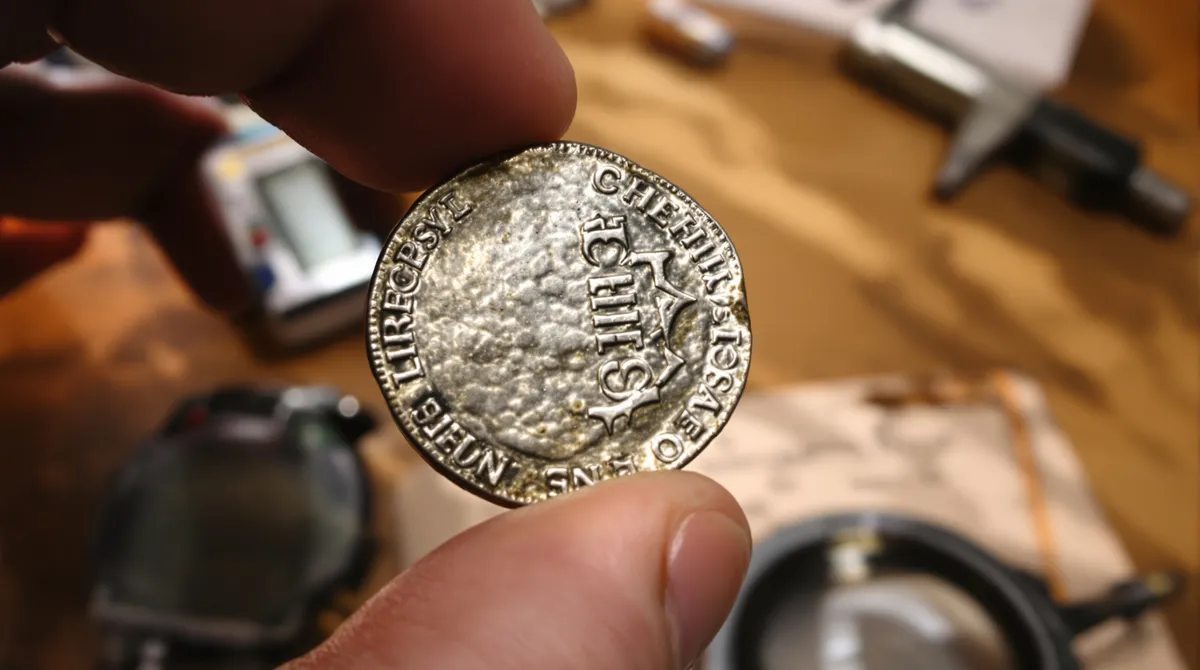
You have dug a disc of metal. It is clearly a coin, it is clearly not modern, and you have absolutely no idea what it is.
Most people at this point do one of two things: upload a blurry photo somewhere and ask “what is this?”, or start cleaning it in the hope that the answer appears. Both waste the information you already have.
There is a better method, and it is the same one museum staff use. You do not need expertise. You need to gather five specific pieces of information, in order, before you search for anything.
Gather the evidence first
Do this before you clean, before you search, and before you ask anyone. Every step here is non-destructive.
1. Measure the diameter
Use digital callipers if you have them, a ruler if you do not. Measure in millimetres, to a decimal place if you can.
Diameter alone eliminates most of the possibilities. Coin sizes were standardised within any given system, so a 20mm coin and a 28mm coin are simply different denominations even if they look identical otherwise.
2. Weigh it
Cheap kitchen scales that read to 0.1g are enough. Weight combined with diameter is close to a fingerprint — it distinguishes silver from a silver-washed base metal, identifies clipped or worn examples, and separates similar-looking denominations.
If a coin weighs noticeably less than the reference for its type, it may be worn, clipped, corroded, or a contemporary counterfeit. All of those are interesting, and none of them are visible in a photo.
3. Identify the metal
You are looking for the broad family, not a lab result:
- Silver — grey, may be toned dark or nearly black, often lighter in the hand than you expect
- Copper or bronze — brown through to green, the most common material for older small change
- Brass — yellower than bronze, often used for tokens and later issues
- Gold — unmistakable, because it comes out looking bright with no corrosion at all
- Nickel, cupronickel, or clad — bright silver-grey and modern-looking, generally 20th century onward
The cleaning guide covers what you can safely do to each of these — the short version is that you should not do anything yet.
4. Describe both sides
Write it down in plain language. Not “a king’s head” but “a right-facing bust with a laurel wreath, long hair to the shoulder.”
Note whether the portrait faces left or right. That single detail is often the difference between one monarch and their successor, and it is one of the most efficient identifiers there is.
On the reverse, describe the central device — a shield, a cross, a harp, a seated figure, a wreath, a coat of arms — and note anything in the fields around it.
5. Transcribe any lettering
This is the highest-value step and the one most people skip because the lettering looks illegible.
Copy down every letter you can make out, using a dot or underscore for the ones you cannot. CAROLVS · D · G · ___ is enormously more useful than “some letters around the edge.”
A few conventions that unlock a lot of European coinage:
- U is written V.
CAROLVSis Charles,AVGVSTVSis Augustus. - D G is Dei Gratia, “by the grace of God” — it follows the ruler’s name.
- REX is king, REGINA is queen, IMP is emperor.
- FID DEF or F D is Fidei Defensor, “Defender of the Faith” — standard on British coinage.
- Roman numerals after a name give the regnal number:
GEORGIVS III.
Even three consecutive readable letters plus a diameter will usually get you there.
Reading the age from manufacture
If there is no date — and on genuinely old coins there usually is not — the way the coin was made tells you roughly when.
Hammered coins were struck by hand between two dies. They are slightly irregular in shape, rarely perfectly round, often show the design off-centre with part of it missing, and have uneven, unfinished edges. Thin, small, wobbly, and irregular means hammered — which in Britain means before roughly 1660.
Milled coins were struck by machine. They are properly circular, evenly struck, consistent in thickness, and frequently have a reeded, grained, or lettered edge. Regular and machine-perfect means later.
That single distinction splits your search space roughly in half before you have looked anything up.
Beyond that: portrait style, lettering style (Gothic script versus Roman capitals), and the presence of a date all narrow the window further. Dates on European coinage become common through the 16th and 17th centuries, so a dateless coin is a hint in itself.
Searching properly
With diameter, weight, metal, design, and partial legend written down, you can search in a way that actually works.
Search the description, not the object. A query like hammered silver 18mm cross reverse CAROLVS will get you somewhere. “Old coin I found” will not.
Use the right references. Numista is free, well structured, and searchable by country, metal, and diameter. For British material, the Portable Antiquities Scheme database contains hundreds of thousands of recorded finds with photographs, which makes it superb for visual matching against something that came out of the same kind of ground as yours. National museum collections are searchable online and authoritative.
Search by shape when the words fail. If you cannot read any lettering, search the reverse design and the diameter together. “Long cross” and “short cross” pennies, for instance, are distinguished almost entirely by the reverse device.
Check contemporary counterfeits. Forged coins were common historically and are legitimately collectable. A coin that nearly matches a reference type but is underweight or crudely struck may well be a period forgery rather than a mis-identification on your part.
Where to get expert help
Once you have done the work above, asking for help becomes far more productive — you are presenting evidence rather than a mystery.
Local detecting clubs are the fastest and friendliest option. Someone in the room has almost certainly dug one before, and they know what turns up locally, which is the single biggest clue.
Finds Liaison Officers, part of the Portable Antiquities Scheme in England and Wales, will identify and record finds free of charge. Recording your finds with the PAS adds them to the national archaeological record, which is genuinely valuable — and in some cases reporting is a legal requirement rather than a courtesy. Our legal checklist covers how to work out what applies where you detect.
Museums and numismatic societies will often help with anything unusual, particularly if it has local significance.
Detecting forums are useful once you have the measurements. Post the diameter, weight, metal, and your best transcription alongside clear photos of both sides on a plain background with good light, and you will usually get a confident answer quickly.
Photograph it properly before you ask
Bad photos are the main reason identification requests go unanswered.
Use diffuse natural light rather than direct flash, which blows out detail on metal surfaces. Shoot both sides. Use a plain, neutral background — grey card is ideal. Include something for scale, or state the measured diameter. Try raking light from a low angle across the surface, which throws shadows into the recessed detail and can make a worn legend readable when flat lighting cannot.
This is the same technique that makes your own find records worth having, and it is covered in more depth in our guide to documenting finds.
Log the identification, not just the find
The identification is data, and it belongs with the rest of the record.
When you finally pin down what something is, go back and record it against the find — the type, the metal, and what you measured. In DetectingLog each find keeps its type, metal, VDI and depth, and the hunt carries the photos and your notes, so the coin, its measurements, and how you identified it stay together instead of scattered across a camera roll and a forum thread you will never locate again.
This matters more than it sounds. Once you have identified a few coins from a site, the dates start clustering, and that cluster tells you what the ground was used for and when. A field producing 17th-century material is a different proposition to one producing Victorian pennies, and it deserves a different plan next time you visit. That is exactly the sort of pattern your hunt data surfaces once you have logged enough of it.
Some coins resist identification for years. That is normal. Record what you measured, note where you got stuck, and come back to it — dug coins have a way of becoming obvious once you have seen a second one.
Frequently asked questions
How do I identify an old coin I found metal detecting?
Work through it systematically: measure the diameter and weight, note the metal, describe the design on both sides, and transcribe any lettering — even partial. Those five data points narrow almost any coin to a short list. Then search on the description rather than uploading a photo and hoping.
How can I tell how old a dug coin is without a date?
Shape and manufacture give it away. Irregular, slightly off-round coins with uneven edges are usually hammered, meaning struck by hand before roughly 1660 in Britain. Perfectly round coins with milled or reeded edges are machine-made and later. Portrait style, lettering style, and metal all narrow it further.
Where can I get a metal detecting find identified for free?
Local detecting clubs are the fastest route and cost nothing. In England and Wales the Portable Antiquities Scheme has Finds Liaison Officers who will identify and record finds free of charge. Museum staff, numismatic societies, and established detecting forums are all good options too.
Keep reading
Recording Finds with the Portable Antiquities Scheme
What the PAS is, why recording your finds is worth doing even though it is voluntary, what a Finds Liaison Officer needs from you, and how the process works.
How to Clean Metal Detecting Finds Without Ruining Them
Most damaged finds are damaged by their finder, not the soil. What is safe to clean, what to leave alone, and the methods that quietly destroy value.
Miner's Right Victoria: Cost, How to Get One and the Rules
A Victorian Miner's Right costs $29.40 for 10 years, rising to $41.40 on 1 January 2027. How to buy one, what it lets you do, and the rules attached.